Researchers have uncovered a new 3D structure of a cancer-linked protein bound to its cellular partner, detailing how it attaches to chromosomes and offering key insights for future disease treatments.
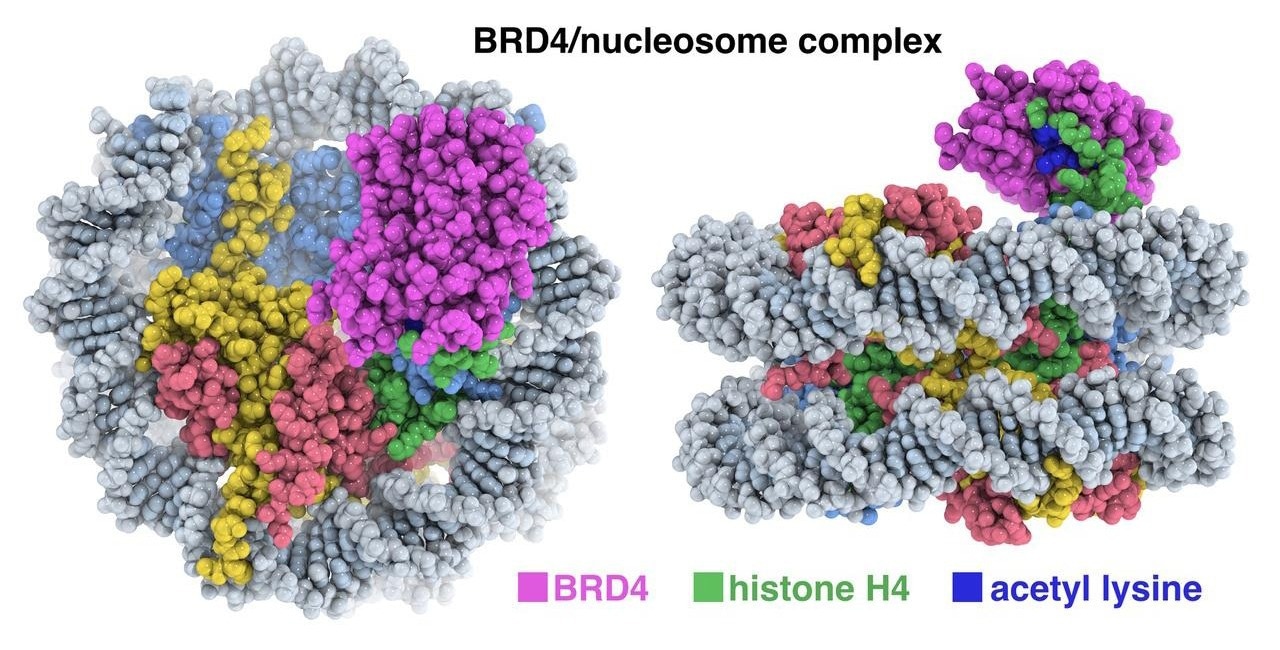 Two views of the cryo-electron microscopy structure of BRD4, a protein that binds to chromosomes to turn gene expression on or off and has been linked to various cancers, in complex with a nucleosome, a part of the chromosome's structure. The new structure confirms that the protein’s bromodomain (pink) binds to a chemically modified amino acid (acetyl lysine, blue) on histone H4 (green), but further experiments show it binds nearly as well to unmodified histones. Image Credit: Song Tan / Penn State.
The protein – BRD4 – serves an essential function in cellular processes, including DNA transcription, replication, and repair, and influences the differentiation of various cell types; it has been implicated in numerous malignancies and represents a significant therapeutic target for forthcoming treatment strategies.
Research by investigators at Penn State, published in Molecular Cell, shows that BRD4 can bind DNA-packaging structures in cells without a molecular signal previously thought to be required for this interaction.
We were motivated to understand the basic biology of BRD4 and what it can teach us about the structure and function of this group of proteins. While the role of BRD4 in cancer was not our immediate focus, as we continue to build a better understanding of its function, we hope to reveal clues that could be used in the development of more effective treatments.
Song Tan, Team Leader and Verne M. Willaman Professor, Molecular Biology, Eberly College of Science, Penn State
BRD4 belongs to a protein family characterized by the presence of bromodomains, which are specialized structural domains. These domains enable BRD4 to attach to chromosomal structures and regulate the activation and suppression of downstream genes. Previously, it was hypothesized that BRD4 establishes its connection to nucleosomes – the fundamental repeating units of chromosomal architecture – through the interaction of its bromodomains with chemically modified histones, which are the protein constituents of nucleosomes that have undergone post-translational modification via the addition of chemical markers, according to the researchers' findings.
Previous studies of BRD4 structure had looked at it bound to a fragment of one of the modified histone proteins. We were keen to see if we could gain additional insight into its structure and function by imaging it bound to an entire nucleosome.
Song Tan, Team Leader and Verne M. Willaman Professor, Molecular Biology, Eberly College of Science, Penn State
The research team used cryo-electron microscopy (cryo-EM), an advanced method that can generate near-atomic-resolution images, to show that BRD4 bound the modified histone as expected while also directly interacting with DNA within the nucleosome. The structural analysis of BRD4 bound to the nucleosome further revealed that upon engagement of one of its bromodomains with a modified histone, the resulting protein configuration establishes a functional platform facilitating interactions with additional proteins.
BRD4 interacts with many other proteins to carry out its function, our 3D structure seems to show it laying out a welcome mat for these interactions. This structural insight will help us begin to piece together exactly how this protein functions. It shows the benefit of imaging BRD4 in its biologically relevant context, bound to an entire nucleosome.
Jiang Zhu, Study Co-First Author and Assistant Research Professor, Biochemistry and Molecular Biology, Penn State
The research team conducted further experiments to determine whether BRD4 retained its ability to bind nucleosomes when the chemical tags on histones were absent. Their findings showed that BRD4 binds unmodified histones with an affinity nearly equivalent to its binding to modified histones.
“This was a total surprise. It was dogma in the field that the acetylation chemical tag on the histone was needed to recruit the bromodomain to nucleosomes, but our research shows that key regions of the BRD4 protein help it to bind to unmodified histones. We don’t yet know if this happens in cells, but if it does, it could open the door for discovering additional contexts in which BRD4 or other bromodomain proteins play important biological roles,” said Erik M. Leith, who completed his doctorate in the biochemistry, microbiology and molecular biology graduate program at Penn State in 2025 and is co-first author of the paper.
Source:
Journal reference:
Zhu, J., et al. (2026) BRD4 binds the nucleosome via both histone and DNA interactions. Molecular Cell. DOI:10.1016/j.molcel.2026.07.012. https://cell.com/molecular-cell/retrieve/pii/S1097276526004983.
 Historic Parchment Unlocks Ancient Genetic History of Sheeppox Virus