Cell division represents a complex process. Central to this intricacy is a cellular structure devoid of a membrane, known as the centrosome, consisting of over 200 different components. This organelle plays a crucial role in gathering mitotic spindles, which are thread-like formations essential for the segregation of genetic information. Determining which elements of the centrosome are required and adequate for the assembly of these spindles has been challenging for a long time.
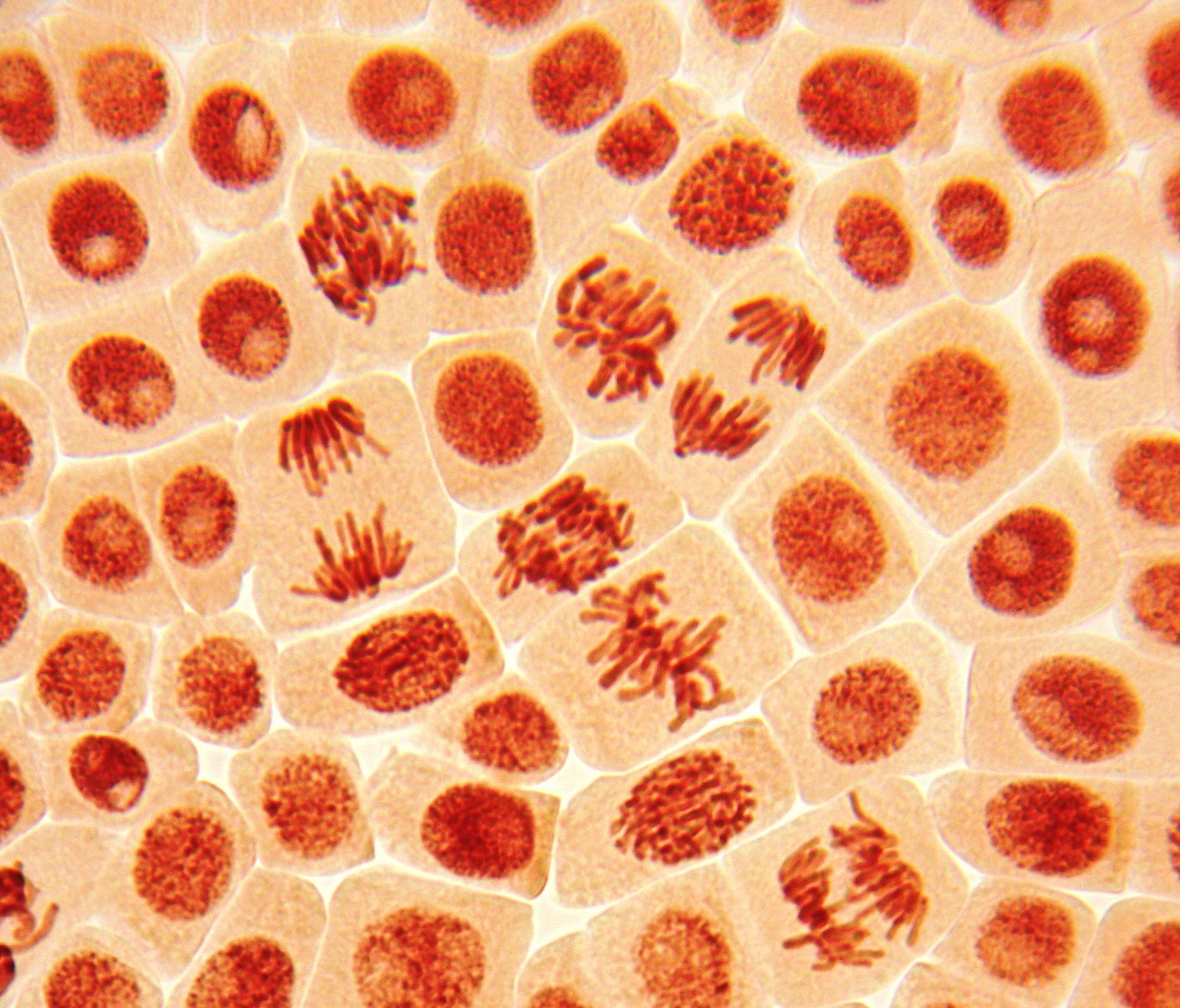 Image credit: Dimarion/Shutterstock.com
Researchers from the Department of Microbiology and Cell Biology at the Indian Institute of Science have created a novel method named Light-Induced Spindle Activation, or LISA. This approach enables reversible activation of Aurora A kinase, an essential centrosomal enzyme that plays a vital role in the formation of the spindle structure.
With this new method, researchers can investigate centrosomes and the spindle assembly process with enhanced precision. Furthermore, it enables the potential recovery of cell division by intentionally altering these elements and mechanisms when they do not function properly. The findings were published in EMBO Reports.
Researchers thought that Aurora A becomes activated through the process of clustering, which is facilitated in cells by its evolutionarily preserved scaffold known as Cep192. Earlier studies indicated that beads coated with Aurora A are capable of initiating microtubule formation in extracts from frog eggs; however, the presence of Cep192 is essential for activating Aurora A in this environment.
Using LISA, scientists can now induce and examine Aurora A clustering in a reversible manner with blue light, without reliance on Cep192, across various cell types. Additionally, LISA can be implemented directly within living cells, while the method involving beads is primarily limited to cell extracts.
In the development of this technique, Sachin Kotak, Associate Professor at MCB, along with his research team, discovered a new use for an established method known as LARIAT, which is generally applied to inhibit proteins through the induction of their clustering via light. The team recognized that this clustering, triggered by light, could be utilized to activate Aurora A kinase instead. LARIAT employs plant proteins CRY2 and CIB1, which can be stimulated to cluster when exposed to blue light.
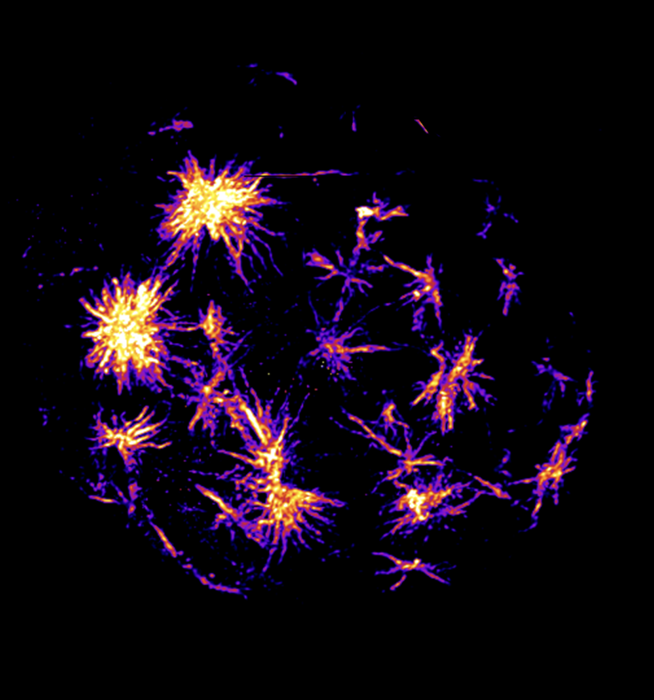 A human cell showing light-induced clustering of Aurora A, which induces the formation of multiple microtubule-organising centres. Image Credit: Vignesh O
The researchers initially modified human cells to produce a fusion protein that connects Aurora A kinase with CRY2. When blue light is directed at this fusion protein, CRY2 undergoes a structural transformation that enhances its interaction with CIB1.
This interaction subsequently leads to the aggregation of multiple Aurora A complexes.
This offers a novel method for initiating and activating an artificial Aurora A kinase complex – specifically, Aurora A linked to light-sensitive plant proteins, which is adequate for promoting microtubule nucleation.
Vignesh Olakkal, PhD Student, Indian Institute of Science
Cells that lack centrosomes frequently exhibit issues with spindle formation, which results in inaccuracies during cell division. The research team led by Kotak aimed to investigate if LISA could fix this issue. Initially, they chemically removed centrosomes from human cells and subsequently incorporated the modified Aurora A clustering system.
Upon exposure to blue light during mitosis, this light prompted Aurora A clustering and effectively enhanced microtubule nucleation. Notably, the activation of Aurora A through light was adequate to reinstate spindle assembly and correct the defects in cell division resulting from the absence of centrosomes.
The researchers suggest that LISA could also have possible uses in therapy.
In many solid tumours, Aurora A kinase is overexpressed, and that’s why there are drugs targeting it. But Aurora A kinase has multiple targets. Now, with our strategy, we can find out what the Aurora A kinase-specific targets are, independent of the centrosome, as far as microtubule nucleation is concerned. Then we will hopefully be able to find other targets of Aurora A kinase and design drugs.
Sachin Kotak, Associate Professor, Department of Microbiology and Cell Biology, Indian Institute of Science
Source:
Journal reference:
Olakkal, V., et al. (2026) Light-induced spindle assembly through Aurora A clustering. EMBO Reports. DOI:10.1038/s44319-026-00928-9. https://link.springer.com/article/10.1038/s44319-026-00928-9.
 Single-Cell Sequencing Confirms Epigenetic Remodeling Across Diverse Cardiac Cell Types