The cell’s powerhouse, known as mitochondria, appears to have the ability to control the quantity of lipid droplets in the cell. A mechanism designed for an entirely different purpose plays a key role here. A new study conducted by the University of Bonn, University Hospital Bonn, and the University of Freiburg supports this finding. The findings have now been published in the journal Nature Cell Biology.
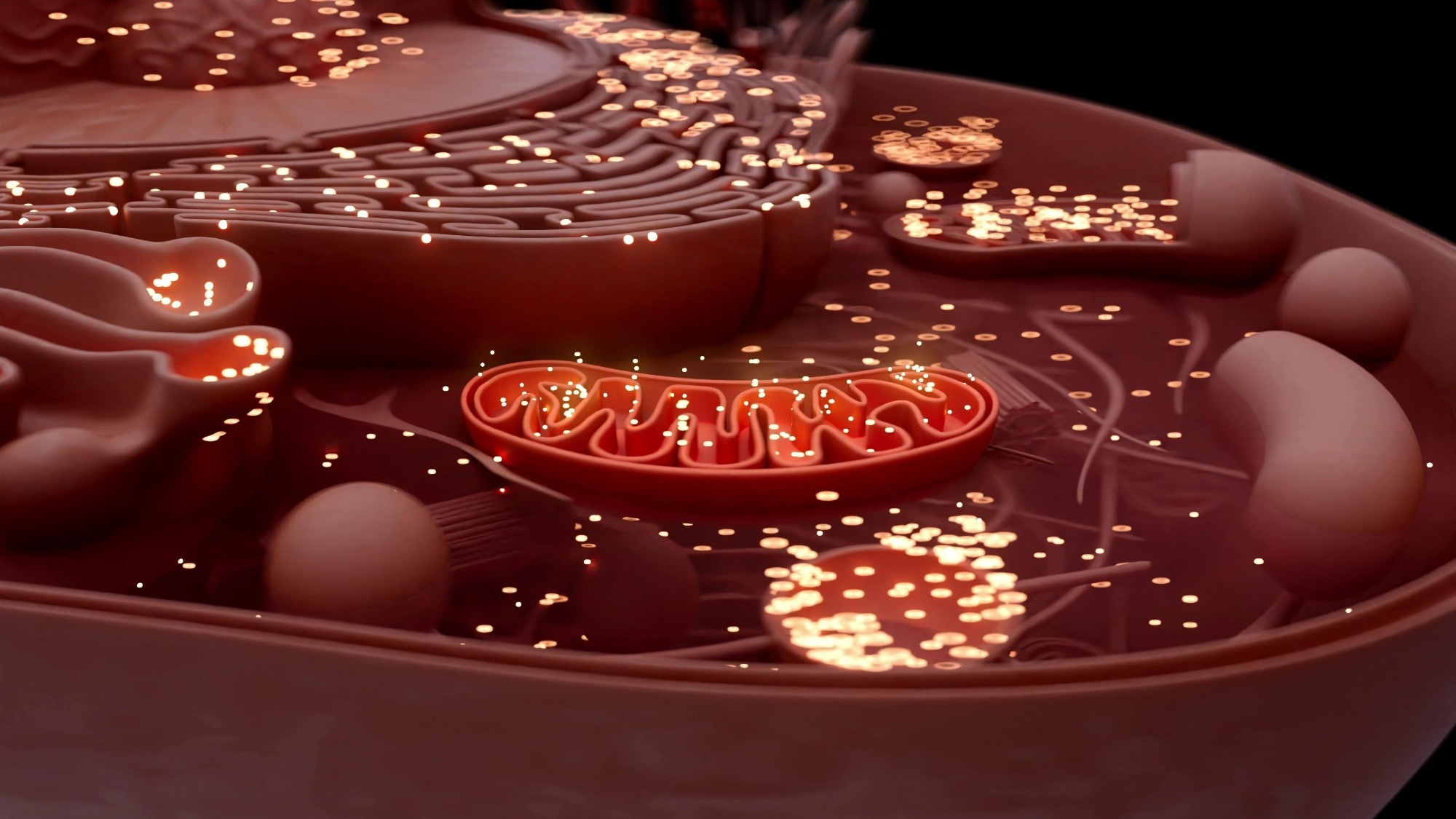 Image credit: Julien Tromeur/Shutterstock.com
The human body follows a precise division of labor. The lungs, for example, are responsible for oxygen absorption, whereas the kidneys filter waste products from the blood. The same idea applies to cells: they have several organelles, each performing a specialized function. The mitochondria are one example. They function as small powerhouses, supplying energy to the cell.
The mitochondria are surrounded by two membranes: the outer and inner mitochondrial membranes. Several proteins are attached to these two membranes. They ensure, for example, that specific molecules can enter the mitochondrion or participate in energy generation. The outer membrane proteins are synthesized in the cytosol, the cell's aqueous basic component, and are incorporated into the membrane.
Molecular Machine Used for a Different Purpose
Many outer membrane proteins have one or more regions that pass through the membrane. These transmembrane sections help hold the protein in place. Their insertion is usually handled by a dedicated molecular machine. This is the MIM complex, which, in baker’s yeast, is located in the outer membrane.
We have now been able to show that this MIM complex also carries out another task. It appears to be able to regulate the quantity of lipid droplets in the cell. Lipid droplets are fat storage within cells.
Dr. Thomas Becker, Director, Institute of Biochemistry and Molecular Biology, University Hospital Bonn
Becker's team identified this previously unknown process in baker's yeast in collaboration with the research groups of Prof. Dr. Nikolaus Pfanner (University of Freiburg) and Prof. Dr. Maria Bohnert (University of Münster). Ayr1 is a crucial enzyme in this process. Ayr1, like the outer membrane proteins, can bind to the MIM complex. Unlike them, it is not incorporated into the membrane.
“It lacks the transmembrane domain for this,” Becker added.
Instead, it remains connected to the MIM complex.
Ayr1 is involved in lipid metabolism and so interacts with lipid droplets within the cell. Its binding to the MIM complex promotes the attachment of lipid droplets to the outer membrane of mitochondria.
This also has an impact on the number of lipid droplets. The more Ayr1 molecules dock onto the MIM complex, the more lipid droplets accumulate in the cell. The binding of Ayr1 changes the function of the MIM complex to such an extent that MIM modulates the number of lipid droplets and thus the cellular lipid metabolism.
Dr. Thomas Becker, Director, Institute of Biochemistry and Molecular Biology, University Hospital Bonn
Mechanisms Could also Exist in Humans
This mechanism has so far only been identified in baker's yeast. However, human mitochondria have a molecular mechanism that incorporates proteins into their outer membrane. Human cells include proteins from the same family as Ayr1.
It is thus possible that the number of lipid droplets in our cells is regulated in a similar manner as in single-cell organisms.
Dr. Thomas Becker, Director, Institute of Biochemistry and Molecular Biology, University Hospital Bonn
Further research is needed to determine how comparable processes exist in human cells and how they could contribute to the development of metabolic diseases.
Source:
Journal reference:
Heinen, S. et.al. (2026) Mitochondria contact lipid droplets through the mitochondrial import complex binding to lipid metabolism enzyme Ayr1. Nature Cell Biology. DOI: 10.1038/s41556-026-01890-3. https://www.nature.com/articles/s41556-026-01890-3.
 Prime Editing Generates Genomic Ticker Tapes Tracing Millions of Developing Cells