A compact protein design dramatically enhances EV-based therapies, offering a more efficient and targeted approach to treat inflammatory diseases such as sepsis and osteoarthritis.
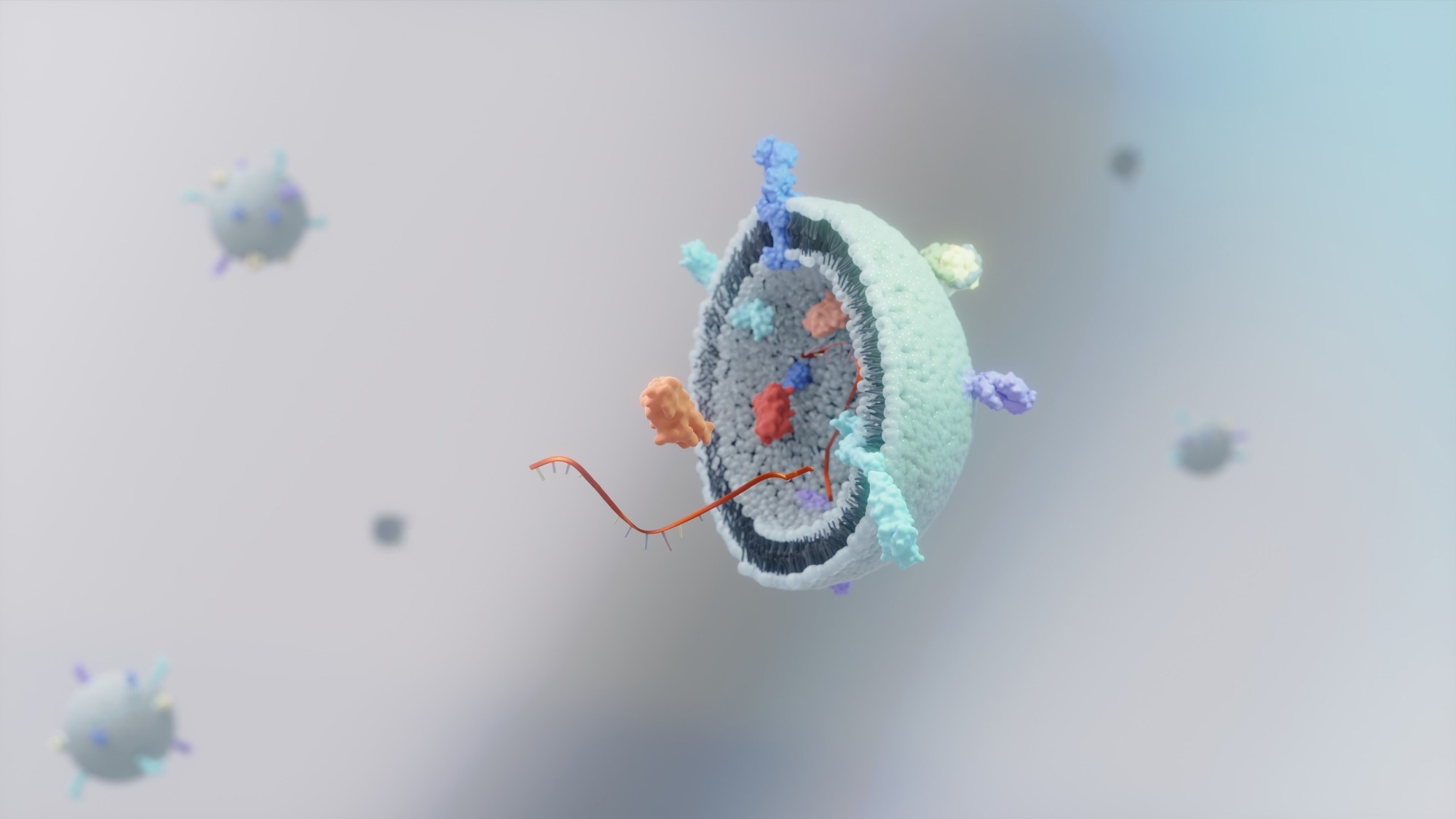 Study: Extracellular vesicle engineering using a small scaffold protein. Image credit: KwangSoo Kim/Shutterstock.com
In a recent study in Nature Communications, researchers report a streamlined strategy to engineer extracellular vesicles, the body’s natural communication carriers, using a minimal scaffold protein.
The team identified EN144, a truncated variant comprising 144 amino acids, that enhances the efficient loading of diverse therapeutic cargo compared with conventional, bulkier scaffolds. By enabling efficient and scalable EV design, this approach shifts the field toward simpler, high-performance systems and supports the development of next-generation therapies targeting inflammatory diseases, including promising early preclinical results in sepsis and osteoarthritis (OA) models.
A Need for Minimal Scaffolds to Improve EV Engineering Efficiency
Extracellular vesicles (EVs) are emerging as promising platforms in drug delivery systems driven by their biocompatibility, low immunogenicity, and role in intercellular communication. They can be loaded with therapeutic cargo either exogenously, via physical methods that may damage EVs, or endogenously, via engineered fusion with EV-sorting proteins that preserve vesicle integrity.
While endogenous loading enables the delivery of larger biomolecules, the lack of simple, efficient scaffold proteins limits progress. Identifying minimal, robust scaffolds is therefore critical to advancing EV engineering. Such innovations are particularly relevant for targeting inflammatory pathways, including interleukin-6 (IL-6) signaling, which is implicated in OA and sepsis.
Multi-Method EV Isolation and Proteomics Validate Scaffold Design
In this study, researchers developed and validated a compact scaffold protein to enhance EV engineering. The team first screened candidate EV-sorting proteins in human embryonic kidney 293 (Expi293F) cells using three complementary isolation methods: ultracentrifugation, magnetic-bead-based EVtrap, and tangential flow filtration combined with size-exclusion chromatography. Subsequently, they performed proteomic analysis using mass spectrometry.
To evaluate sorting efficiency, researchers fused candidate proteins with enhanced green fluorescent protein (EGFP). They then quantified EV-associated fluorescence using Western blotting. The investigators analyzed and benchmarked top-performing candidates, including ENPP1 and Ras-related protein Rab-7a (Rab7a), against established scaffolds such as prostaglandin F2 receptor negative regulator (PTGFRN) and lysosomal-associated membrane protein 2B (Lamp2b).
The team then optimized ENPP1 to generate EN144, a truncated 144-amino acid scaffold. They assessed EN144’s cargo-loading capacity by genetically fusing it with therapeutic proteins and ribonucleic acid (RNA) molecules. Researchers characterized the engineered EVs for physicochemical properties, protein composition, cellular uptake, and cytotoxicity across multiple cell lines. They also performed quantitative assays to compare cargo incorporation efficiency and targeting performance against conventional EV-loading proteins.
For functional validation, the team fused EN144 to glycoprotein 130 (gp130) to generate EVs targeting IL-6-mediated inflammation. Mechanistically, these engineered EVs bind the IL-6/IL-6 receptor (IL-6R) complex, enabling selective inhibition of IL-6 trans-signaling while largely preserving classical IL-6 signaling, and may also modulate broader IL-6 family cytokine pathways through gp130 interactions.
For analysis, they used lipopolysaccharide (LPS)-stimulated macrophages and mouse models of sepsis. In mice, they evaluated survival rates, inflammatory marker expression, and disease severity. In addition, they assessed biodistribution and toxicity following systemic administration. Lastly, the team examined the therapeutic potential in a rat OA model, including a cartilage-targeting design incorporating a chondrocyte-affinity peptide (CAP), assessing cartilage-targeted delivery and tissue repair.
EN144 Enhances Cargo Loading and Cellular Uptake Efficiency
EN144 demonstrated markedly superior performance compared with conventional EV-loading proteins. It achieved consistently higher incorporation efficiency across diverse cargo types, including proteins and RNA, with nanoscale flow cytometry showing high loading efficiencies (approaching ~90 % in certain assays).
Notably, EN144-enabled EVs exhibited a threefold increase in cargo loading compared with full-length ENPP1 and maintained robust performance across multiple cell types. Proteomic analyses further indicated broad preservation of key EV-associated protein signatures despite measurable changes in protein abundance, supporting the physiological compatibility of EVs.
Functionally, EN144 enhanced both luminal and surface cargo delivery, leading to efficient cellular uptake and intracellular release. In vitro, engineered EVs showed high uptake rates, reaching approximately 90 % in chondrocytes, and demonstrated overall low cytotoxicity across tested conditions, with only limited, non-dose-dependent effects observed in some assays and no significant effects on cell viability, oxidative stress, or migration. In vivo safety assessments revealed no abnormalities in organ histology or blood biochemical markers, confirming a favorable safety profile.
Therapeutically, EN144-based EVs showed strong anti-inflammatory effects by targeting IL-6. In sepsis models, the EVs significantly reduced systemic inflammation and improved survival, achieving over 80 % survival at standard doses and complete protection at higher doses, outperforming soluble gp130 (sgp130) comparator treatments. With few effective treatments for sepsis, this approach offers a promising new strategy to improve outcomes using biologically derived delivery systems.
When engineered for cartilage targeting, EN144-EVs enhanced tissue retention, reduced inflammation, and promoted cartilage repair in OA models. Collectively, these findings demonstrate that EN144 is a highly efficient, safe, and versatile scaffold for advanced EV-based therapies.
EN144 Platform Supports Scalable and Versatile Drug Delivery
The findings demonstrate that a minimal scaffold protein can substantially advance EV engineering by combining simplicity with high efficiency. This streamlined design markedly enhances drug delivery performance, underscoring a “less is more” approach that could reshape therapeutic development.
EN144 improved cargo loading and targeting precision while delivering strong therapeutic benefits in preclinical models, particularly in sepsis, where enhanced survival highlights its clinical potential. Its modular design enables seamless integration of diverse therapeutic cargos, supporting potential future applications across a broad range of disease areas.
The simplified architecture supports scalability and manufacturability, critical for clinical translation. However, as these findings are based on preclinical models, further studies are needed to establish long-term safety, efficacy, and clinical applicability in humans. Future studies should focus on refining scaffold variants, establishing long-term safety, and advancing toward clinical trials to position EV-based therapies as a viable drug delivery platform.
Download your PDF copy by clicking here.
Journal Reference
Yan, W. et al. (2026). Extracellular vesicle engineering using a small scaffold protein. Nature Communications. DOI: 10.1038/s41467-026-70451-x. https://www.nature.com/articles/s41467-026-70451-x
 Researchers Decode High-Pressure Survival Strategy of Deep-Sea Bacteria