Scientists reveal that viruses infecting bacteria can “listen” to signals from unrelated phages, altering life-or-death infection decisions and reshaping microbial ecosystems in ways previously thought impossible.
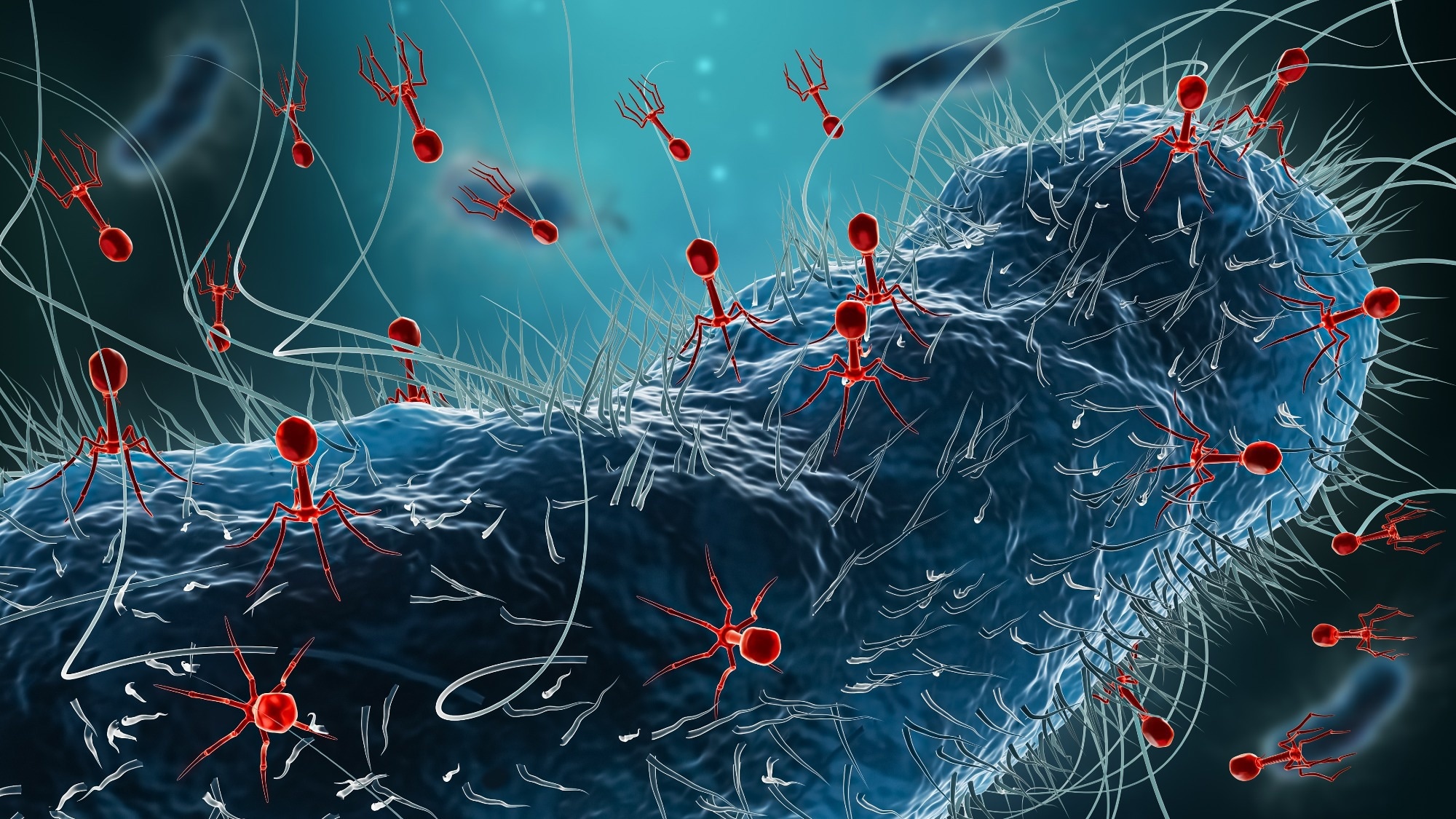 Study: Phages communicate across species to shape microbial ecosystems. Image credit: MattL_Images/Shutterstock.com
A recent study published in Cell challenges a long-standing view of viral communication, showing that bacteriophages can “talk” across related bacterial species within the Bacillus genus. Researchers found that arbitrium signaling peptides, previously thought to act only within closely related phages, can also influence unrelated phages by binding to their receptors, shifting viral decisions toward lysogeny.
Observed in phages associated with multiple Bacillus species, this cross-communication reveals an additional layer of interaction that may shape microbial ecosystems in complex environments. Since bacteriophages are among the most abundant biological entities on Earth and key regulators of bacterial populations, this interaction could influence microbiomes and the spread of mobile genetic elements, including those linked to antibiotic resistance, suggesting potential relevance to both environmental and human health.
Arbitrium Peptides Control Phage Lysis–Lysogeny Decisions
Arbitrium peptide signaling systems enable temperate bacteriophages to regulate the switch between lysis and lysogeny through the accumulation of secreted peptides that modulate receptor activity. While these systems are widespread and highly diverse across phages and other mobile genetic elements, they are widely thought to operate with strict specificity, with each receptor responding only to its cognate (i.e., matching) peptide.
This assumption has limited research into interactions beyond closely related phage groups. Determining whether arbitrium signals can mediate communication between phages associated with different host species is critical for understanding how phages collectively influence infection dynamics, bacterial evolution, and the structure of microbial communities.
Engineered Phages and Assays Test Cross-Species Signaling
In this study, researchers combined computational, genetic, biochemical, and structural approaches to investigate potential cross-communication among arbitrium signaling networks. They first performed a deep phylogenetic analysis of clade 2 arbitrium systems, identifying 281 distinct arbitrium receptors (AimR) based on sequence divergence.
To experimentally assess crosstalk, the team selected well-characterized phages: SPbeta phage, Phi3T phage, and Goe11 phage, and tested whether synthetic non-matching arbitrium communication peptides (AimP) could inhibit prophage induction following mitomycin C treatment. They extended this analysis to phage 13952 to examine interactions across phages capable of infecting different bacterial hosts.
To mimic natural signaling, the investigators generated ΔaimP6AA mutants lacking mature peptides and conducted supernatant exchange experiments between infected cultures to evaluate interference with induction. They also engineered chimeric phages expressing non-matching peptides to directly test functional crosstalk during infection.
Biochemical assays, including thermofluor analysis, isothermal titration calorimetry, and electrophoretic mobility shift assays (EMSA), quantified peptide–receptor binding and functional inhibition. Transcriptional reporter systems further assessed the impact of these interactions on AimR activity.
For structural insights, the researchers solved high-resolution crystal structures of AimR receptors alone and in complex with both matching and non-matching peptides. Lastly, they examined ecological relevance by analyzing mixed lysogenic cultures and double lysogens, with and without mitomycin C induction, to measure phage production under both induced and spontaneous conditions.
Crosstalk Shapes Infection Outcomes in Mixed Phage Communities
The study demonstrates that arbitrium signaling is not strictly species-specific, as several AimP peptides bound and repressed non-matching AimR receptors, shifting phage behavior toward lysogeny and reducing prophage induction by up to 1,000-fold. Notably, peptides produced by Bacillus amyloliquefaciens phage 13952 and Bacillus subtilis phage Goe11 exhibited “symmetric crosstalk,” with each peptide effectively inhibiting the other’s receptor at levels comparable to cognate interactions. In contrast, systems such as Phi3T phage retained strict specificity, highlighting variability in cross-communication.
Sequence analysis revealed that most peptides share a conserved “RGA” motif, with only a few amino acid positions determining receptor specificity, limiting overall signal diversity. Functional assays showed that non-matching peptides could suppress phage induction by up to 1,000-fold and enhance bacterial survival, confirming their biological relevance. Biochemical measurements further supported these findings, with non-matching peptides binding receptors at nanomolar affinities comparable to matching interactions.
Structural analyses explained this phenomenon by showing that AimR receptors undergo nearly identical conformational changes when bound to matching or certain non-matching peptides, enabling cross-recognition with minimal structural adjustments. Importantly, in mixed and co-infected cultures, the presence of a single peptide-producing phage was sufficient to suppress induction of multiple phages, demonstrating community-level effects.
Additionally, crosstalk was shown to favor lysogeny of incoming phages in cells already carrying compatible prophages, highlighting its role during infection. Together, these results establish that arbitrium-mediated crosstalk can operate across related species, influencing infection outcomes and reshaping phage–bacteria dynamics in natural environments, while remaining selective rather than universal across all systems.
Viral Communication Networks Extend Beyond Single-Species Boundaries
The findings redefine the scope of viral communication by showing that arbitrium signaling can facilitate cross-talk among distinct phage groups, even across different bacterial hosts such as B. amyloliquefaciens, B. atrophaeus, and B. subtilis. This expanded signaling network suggests that phages can collectively influence infection dynamics, host survival, and the dissemination of mobile genetic elements.
The results point to a finely tuned evolutionary balance between preserving signaling specificity and allowing advantageous cross-communication, with even single amino acid differences capable of determining whether such interactions occur.
Future work should examine the prevalence of such interactions across different arbitrium clades and mobile genetic elements, along with the role of environmental conditions in shaping peptide-mediated signaling. However, the current study is limited to a subset of arbitrium systems and does not directly measure peptide concentrations in natural settings, which may influence the extent of crosstalk in real-world environments.
These insights may support the development of new approaches in microbiome engineering and phage-based therapies, including programmable systems designed to regulate microbial communities and address antimicrobial resistance. As research progresses, understanding and leveraging communication between phages could enable more precise control over microbial ecosystems.
Download your PDF copy by clicking here.
Journal Reference
Gallego-del-Sol, F. et al. (2026). Phages communicate across species to shape microbial ecosystems. Cell, DOI: 10.1016/j.cell.2026.03.004. https://www.cell.com/cell/fulltext/S0092-8674(26)00271-0
 Mobile Genetic Elements and Reservoir Type Drive Resistance-Gene Abundance in Water Sources