Scientists discovered that horseshoe bats don’t just hear better in cluttered forests; they actively reshape the acoustic landscape around them, creating quiet frequency zones that make fluttering prey easier to detect.
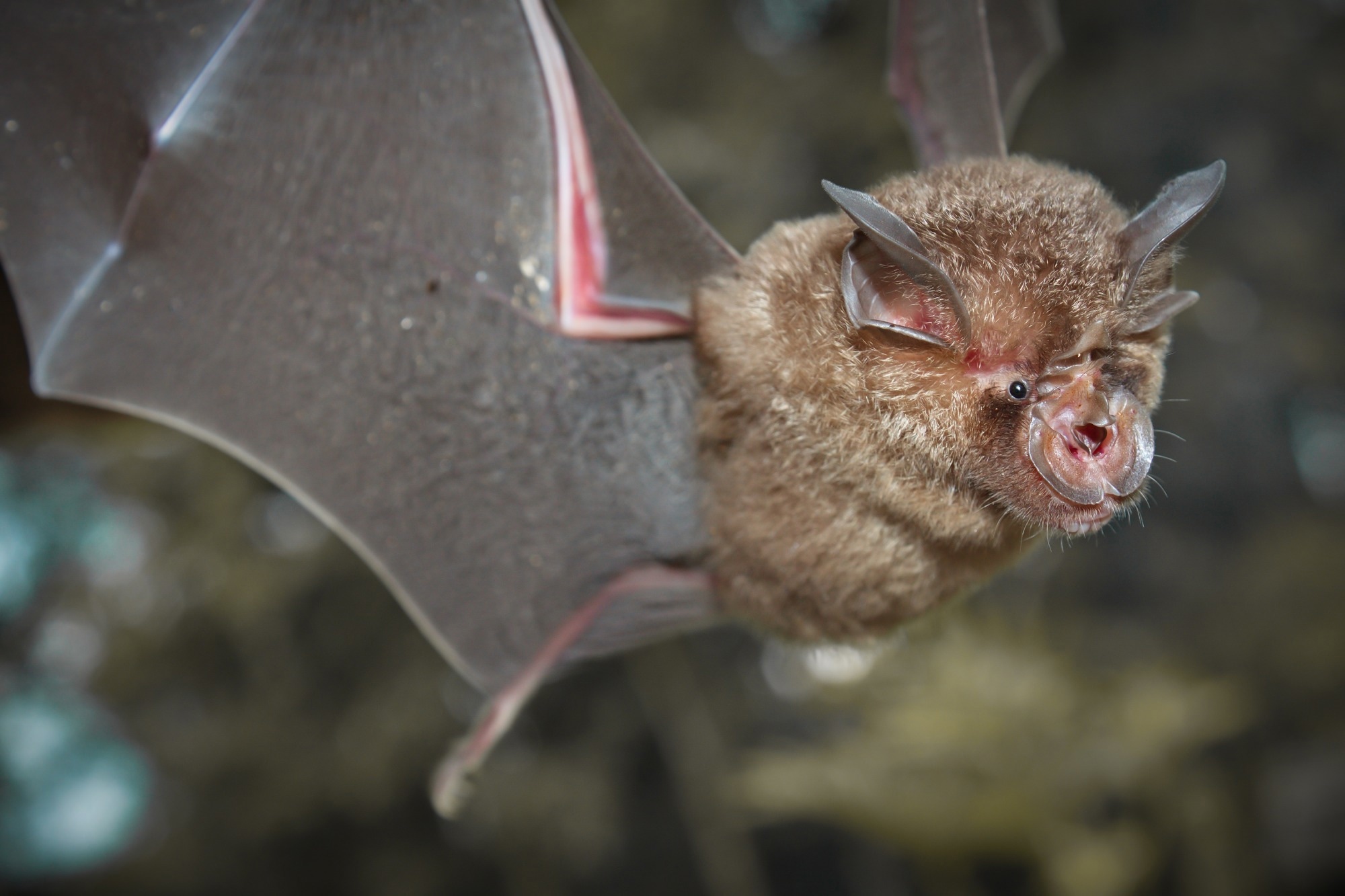 Study: Horseshoe bats (Rhinolophus nippon) suppress clutter noise through echolocation frequency control to detect prey. Image credit: Binturong-tonoscarpe/Shutterstock.com
A recent study published in Communications Biology reveals that horseshoe bats (Rhinolophus nippon) have a surprisingly advanced way of filtering out background noise while hunting. Instead of simply ‘hearing better’, they adjust the pitch of their own echolocation calls to create quieter frequency windows in which prey signals stand out more clearly. Bats adjust their call frequencies in ways that make even tiny movements, like the flutter of a moth’s wings, easier to detect in noisy environments such as forests.
Bats Prioritize Background Echoes Over Prey Signals
Scientists are exploring mechanisms by which bats manage to detect even tiny insects amid multiple echoes and background clutter in forests. Bats constantly produce sound calls and listen to the returning echoes to navigate and hunt. They also adjust the pitch of their calls during flight, a phenomenon known as Doppler shift compensation (DSC), so the echoes stay within the range their ears detect best, the acoustic fovea.
In previous investigations, scientists found something surprising. Rather than focusing on echoes from their prey, bats adapted to echoes from nearby plants or walls. This intrigued researchers to investigate whether bats use their sound-adjusting behavior for something more sophisticated than simply sharpening their hearing.
Playback Experiments Reveal Echo Selection Strategies
In the present study, researchers performed a series of behavioral and acoustic experiments to investigate whether DSC in Greater Japanese horseshoe bats serves functions beyond maintaining echoes within the auditory fovea. They aimed to define the mechanisms that help bats decide which sounds to focus on while hunting.
The team housed bats under cave-like environmental conditions before testing. They performed two types of experiments. One included real-time playbacks with phantom echoes, whereas the other allowed free flight in controlled settings. The real-time playback experiment determined how bats select target echoes during DSC. The free-flight trials recorded the actual echoes that bats perceived.
In the real-time playback experiments, ultrasonic microphones captured the bat calls emitted. The experiment comprised one strong echo along with four weaker echoes. The echoes had different frequency shifts. The team analyzed bat calls to investigate whether bats focused on echoes with maximum intensity or those with the highest frequency.
In the free-flight experiment, the team allowed the bats to fly freely within a chamber specifically designed with echoic and sound-attenuating walls. The different wall surfaces were included to separate echo intensity from Doppler-shifted frequency under controlled conditions. The team attached microphones to the bats to record echoes during flight in controlled yet more natural settings.
In addition, the researchers presented moths as prey, deliberately blocking certain sound frequencies with background noise. They played narrow-band Gaussian noise above or below the reference frequency. The team observed whether the bats attacked the moths or ignored them to ascertain the most critical sound frequencies for successful hunting.
Bats Follow Highest-Frequency Echoes While Hunting
The experiments showed that bats do not focus on the loudest sounds when hunting. Instead, they focus on the highest-frequency ones, even if those echoes are weak. These findings demonstrate that echo frequency rather than intensity primarily guides DSC in horseshoe bats.
By adjusting the pitch of their own calls, bats push most background echo clutter into a lower sound range. This leaves a quieter “sound window” where important prey signals can stand out. The free-flight experiment recordings revealed that echoes above the reference frequency were largely absent, and strong background echoes were concentrated below it. This created the silent spectral window above the reference frequency.
When moths flap their wings, they generate brief, high-pitched echoes. The frequency of these sounds appeared to lie within this silent zone. Due to the limited background echo clutter, the moth signals stood out. As a result, bats could detect these insects more easily. The brief prey-generated glints themselves were too unstable and short-lived to guide DSC, but they became easier to detect within the quiet spectral window.
The researchers confirmed this by adding artificial noise during hunting experiments. When noise was added outside the silent zone, the bats still successfully initiated attacks on prey. But when noise was added inside the quiet zone (above the reference frequency), attack rates dropped sharply. These findings suggest that bats don’t just stabilize echoes in the auditory fovea. They actively shape the surrounding sound environment by reducing background noise to more easily detect their prey.
Bats Physically Reshape Soundscapes During Hunting
The findings suggest that while bats' hearing systems are finely tuned to certain sounds, their echolocation calls are adjusted to reduce background noise. These approaches help bats process information more effectively in regions with multiple echoes. The findings could also help inspire future technologies based on similar systems. The researchers suggest the work may have broader implications for active sensing systems that must extract signals from cluttered environments.
Future studies could clarify how accurately the bats make these adjustments or whether other factors, such as how steady or long-lasting the echoes are, also affect their decisions. Further investigations should test bats in different real-world situations, for example, when prey is present versus absent, to better understand why this behavior evolved and how it helps bats survive.
Download your PDF copy by clicking here.
Journal Reference
Yoshida, S., Mastumoto, H., Kobayasi, K.I. et al. (2026). Horseshoe bats (Rhinolophus nippon) suppress clutter noise through echolocation frequency control to detect prey. Communications Biology, 9, 663. DOI: 10.1038/s42003-026-10217-9. https://www.nature.com/articles/s42003-026-10217-9
 Researchers Outline Quantitative Principles of Cell Signaling Time Codes