By combining multiple organoids and specialized cell types into a single self-organizing system, assembloids recreate key features of human tissues that conventional models miss, opening new opportunities for disease research, drug testing, and regenerative medicine.
 Study: Assembloids: The next dimension in organoid research. Image credit: murat photographer/Shutterstock.com
In a recent review published in Cell Biomaterials, researchers discuss assembloids, an advance on conventional organoids that more accurately reproduce the structural and functional characteristics of human organ systems. Assembloids are formed by integrating multiple organoids and specialized cells in a single platform to enhance the study of diseases and develop and test potential treatments.
Why Researchers Are Moving Beyond Organoids
Scientists have long used animal models to study biological mechanisms underlying human diseases and develop targeted therapies. These models exhibit species-specific differences that limit their accuracy and generalizability. Conventional in vitro models face similar constraints.
Two-dimensional cell cultures do not precisely simulate intercellular communication. Although cell sheets and spheroids provide partial improvements, they often lack long-term stability and cannot fully replicate the structural complexity of native tissues. While organoids provide three-dimensional replicas of organs and tissues, they often lack blood vessels, nerves, and immune cells, which are important for studying organ function and disease-related changes.
In this review, the authors discuss the development, advantages, recent advances, and applications of assembloids in biomedical research.
Integrating Multiple Cell Types Into One Model
Assembloids are next-generation models formed by combining multiple organoids and integrating various specialized cell types. These models help researchers study structural and functional alterations in different organs using a single platform. Moreover, these models incorporate blood vessels, immune cells, nerves, and connective tissues to study interactions among systems that are linked to one another.
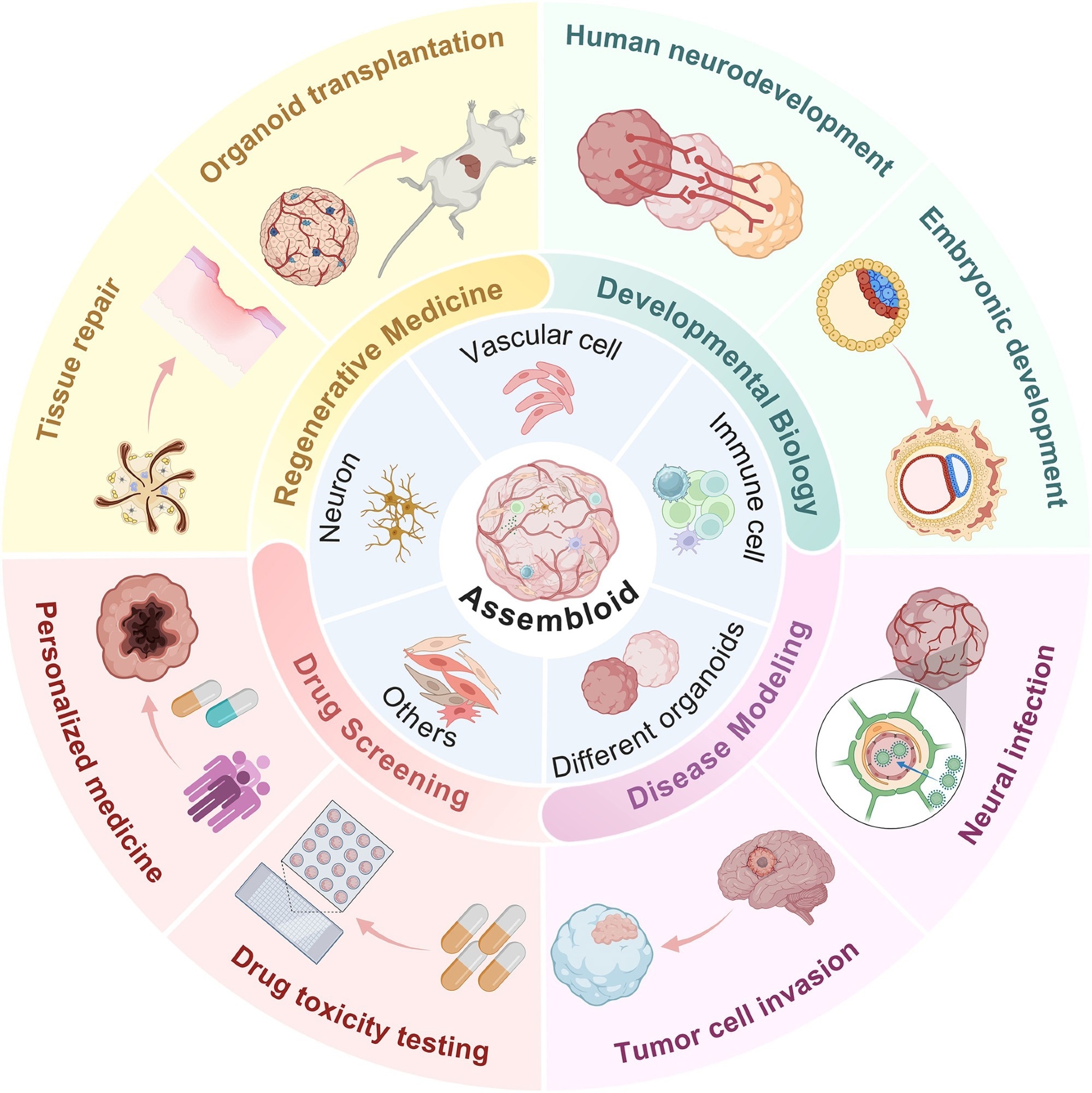 Assembloids are self-organizing three-dimensional structures formed by integrating different organoids and specialized cell types, including vascular, neural, and immune cells. These advanced models support research in developmental biology, disease modeling, drug screening, personalized medicine, tissue repair, organoid transplantation, and regenerative medicine by more closely replicating the complexity of human tissues and organs. Image credit: Li et al. (2026).
This is especially relevant for studying complex diseases that involve interactions among multiple organs and physiological systems. A major focus of the review is the development of methods to incorporate vascular, neural, and immune components into organoids to enhance their physiological realism. Such systems may eventually enable researchers to investigate how vascular, neural, and immune signals influence interconnected tissues.
An important advantage is that assembloids can recreate complex cell-to-cell communication. For instance, these models can recreate epithelial-mesenchymal interactions (EMI) by incorporating both epithelium and mesenchymal tissues within a single system. This helps scientists investigate developmental processes and disease mechanisms with greater physiological relevance than traditional methods. For example, brain assembloids have allowed researchers to study how nerve cells move to their correct locations and connect with one another to form functional brain networks.
To develop assembloids, scientists usually place either pluripotent stem cell-derived specialized cells or cells isolated directly from tissues close together to allow natural fusion. Factors such as the source of assembloid cells, the proportion of different cell types, and the maturity of component tissues can influence assembloid formation.
Including signaling molecules such as vascular endothelial growth factor (VEGF), connective tissue components such as extracellular matrix (ECM) scaffolds, and biomechanical factors such as tissue stretchability and fluid flow can improve replication accuracy.
Bioengineering Tools Expand Assembloid Complexity
Scientists are trying to incorporate developmental features, improved biomaterials, three-dimensional bioprinting, and microfluidic devices to recreate the structural and functional complexities of different organs and tissues.
For instance, they have developed a technique called the dual orthogonal-morphogen-assisted patterning system (Duo-MAPS) that uses carefully controlled chemical signals to guide stem cells to form distinct brain regions within a single assembloid. This helps scientists study how different parts of the brain develop and interact with one another.
Such assembloids could also help identify the different cells and pathways involved in a brain disease, thereby enabling the development of alternative therapeutic strategies and supporting more personalized therapeutic development in the future.
Using organ-on-chip systems, researchers can better replicate the biological mechanisms that drive disease progression. They can identify functional changes, such as blood flow alterations, and biomechanical alterations, such as changes in shear stress in diseases.
Today, researchers have developed assembloid systems that model tissues such as the liver, pancreas, and bile ducts. Cardiac assembloids are helping scientists understand how electrical signals travel through the heart and identify mechanisms underlying certain rhythm disorders.
Blood-brain barrier (BBB) assembloids are being used to study infections and to test whether certain drugs can reach the brain. Researchers have developed intestinal assembloids that help investigate gastrointestinal disorders such as Crohn’s disease. Tumor assembloids more closely mimic the tumor microenvironment (TME) than previous models, thereby improving the accuracy of drug testing.
Multi-organ assembloid systems may provide a more realistic platform for studying how drugs are processed and affect different tissues. The review also highlights their long-term potential for tissue repair and transplantation, as well as broader regenerative medicine applications.
Assembloids Advance Drug Discovery And Regeneration
The review highlights how assembloids are transforming pharmaceutical drug screening, safety testing, and regenerative medicine. By integrating different tissues and organs, these advanced model systems can reproduce structural, functional, and biomechanical aspects of a disease to develop and test new treatments targeting one or more pathways.
Scientists need to establish standardized protocols for robust quality control and develop strategies to make assembloids more cost-effective and scalable. The use of synthetic biomaterials, microfluidic perfusion platforms, single-cell profiling, and artificial intelligence-assisted optimization is expected to accelerate the translation of assembloids from laboratories to clinical practice.
Download your PDF copy by clicking here.
Journal Reference
Li, Z., Rao, Q., Ma, N. et al. (2026). Assembloids: The next dimension in organoid research. Cell Biomaterials, DOI: 10.1016/j.celbio.2026.100488. https://www.cell.com/cell-biomaterials/fulltext/S3050-5623(26)00144-3
 Metabolic Reprogramming Enhances Gamma Delta CAR T Solid Tumor Clearance