King's College London neuroscientists examined the fish over the first five days of their lives to see if the visual characteristics of their upbringing had an impact on the development of the eye's cells. According to the study, which was published in Neuron, fish raised in environments with horizontal stripes develop neurons with distinct shapes and behaviors from those raised in environments with vertical stripes.
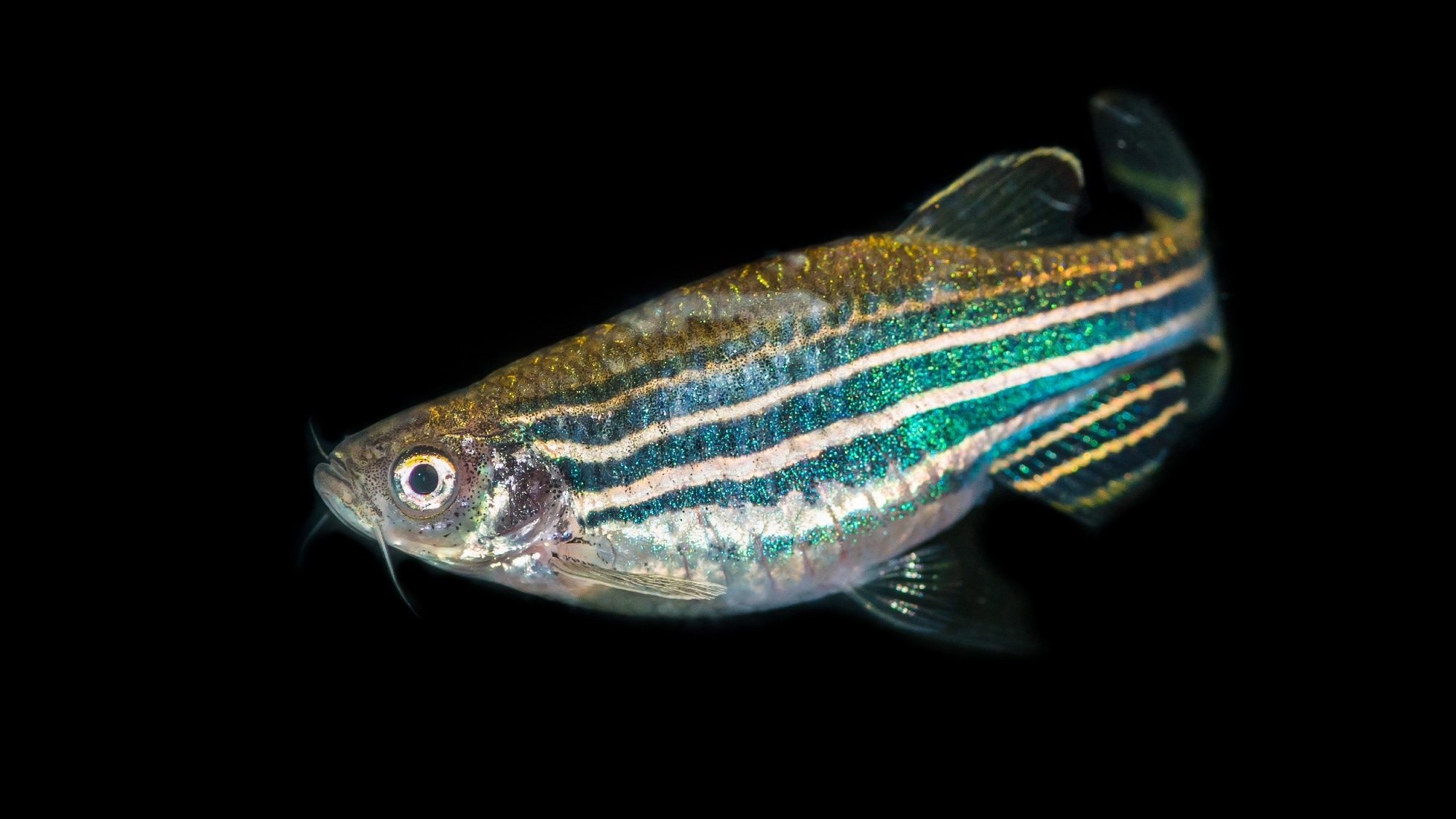 Image credit: Ian Grainger/Shutterstock.com
Researchers demonstrated how these structural and functional variations in the neurons affect the fish's behavior using a virtual reality behavioral test created in partnership with the University of Konstanz. Zebrafish naturally gravitate toward stripes that line up with their body's orientation.
The study tested the strength of preference using virtual reality and discovered that fish raised in surroundings with horizontal stripes had significantly less of this instinct, while fish raised in surroundings with vertical lines retain it.
For the first time, studies have demonstrated how various settings affect the general structure of neurons in the eye and how this affects subsequent behavior. The retina, a structure at the rear of the eye that is in charge of light detection and fundamental visual processing, displayed these alterations.
We were extremely surprised and excited to find experience-based plasticity at this level in a primary sensory organ – the retina. Neither humans nor fish are born with a fully developed eye and brain. Many neurons are physically present but will be refined further - through a process known as plasticity - before adulthood. Classically, the retina has been portrayed as ‘hardware’ and refinement was previously thought to occur mostly inside highly adaptable parts of the brain such as the cerebral cortex.
Robert Hindges, Professor of Developmental Neurobiology, Institute of Psychiatry, Psychology & Neuroscience, King's College London
This study contributes to the increasing amount of data demonstrating that the retina preprocesses the visual scene before sending it to the rest of the brain for additional processing. This is the first study to demonstrate how the visual environment in which the retina and fish are developing affects this pre-processing.
For the first five days of their life, researchers put fish in either horizontal or vertical striped surroundings to see if the environment could affect how the eye develops. All animals use stripes, which are extremely noticeable visual characteristics, to better comprehend what they are looking at.
 Mixed media collage showing artist’s interpretation of investigating retinal orientation-selectivity and brain plasticity in zebrafish. The artwork uses a combination of elements relevant to the study, such as microscopy images, natural visual scenes and black and white gratings. Image Credit: Lisa Pettibone
“People actually use horizontal and vertical features to make sense of more complex images like faces, where the nose is a strong vertical line, and the brow is a clear horizontal line,” explains Professor Hindges.
Half of the fish grew up in a world filled with horizontal stripes. The other half saw simply vertical lines. The researchers found that the neurons in the retinas of the two groups of fish had different shapes when they used a microscope to scan the neurons. The stripes the fish had seen during these initial days after birth also influenced the neuronal activity that is transmitted from the eye to the rest of the brain in the retina.
This has a striking potential to suggest that the places we grow up influence how we see the world. This is in keeping with studies in humans that have shown that people who grow up in different visual environments perceive optical illusions differently. What wasn’t known was that these changes are being at least partially driven by changes in the earliest stage of visual processing: in the retina.
Robert Hindges, Professor of Developmental Neurobiology, Institute of Psychiatry, Psychology & Neuroscience, King's College London
After five days, the researchers examined if these alterations in the retina had an impact on the fish's behavior. This behavioral test took advantage of the zebrafish's natural inclination to turn toward stripes that run parallel to their bodies, which depends on their capacity to distinguish between various stripe orientations.
The fish were given the option to turn in the direction of stripes that were either parallel to or perpendicular to them using a virtual reality system that records motions as they happen. The zebrafish that were raised in a horizontal environment did not exhibit this natural preference for parallel stripes; instead, they appeared to struggle more to distinguish between horizontal and vertical stripes. The fish that were raised in the world with vertical stripes, however, continued to have this predilection.
We wanted to explore how these changes that are happening in the eye can impact the actual behavior of the fish. To do this, we developed a novel behavioral test in virtual reality where the fish can display a preference for lines of certain orientations. This let us test whether their innate preferences were affected by the environment they were raised in.
Dr. Phoebe Reynolds, Study First Author, King's College London
"The design of the tracking setup and the behavioral paradigms were inspired by our observations of the structural and functional changes in the retina. Whether these features would also impact the ability to distinguish stripe patterns during behavior was completely unclear. We were therefore very surprised that the conditions in which the animals were raised indeed had a major impact on performance," adds Professor Armin Bahl from the “Centre for the Advanced Study of Collective Behaviour” of the University of Konstanz, who led the behavioral experiments in this study.
Researchers isolated the role of retinal plasticity in this behavior by a genetic alteration. The fish from both habitats responded in the same way in the absence of the influence of retinal plasticity, indicating that changes in the biology of the eye are responsible for their behavior.
Source:
Journal reference:
Reynolds, P., et al. (2026). Early visual experience elicits cellular and functional plasticity in the retina and alters behavior. Neuron. DOI: 10.1016/j.neuron.2026.05.001. https://www.cell.com/neuron/fulltext/S0896-6273(26)00372-7?_returnURL.
 Researchers Locate Cortical Cells That Actively Trigger Brain Sleep