A portable reader, dual-mode optical detection, and neural network analysis converge in a single serum test designed to move complex cardiac biomarker measurements closer to the point of care.
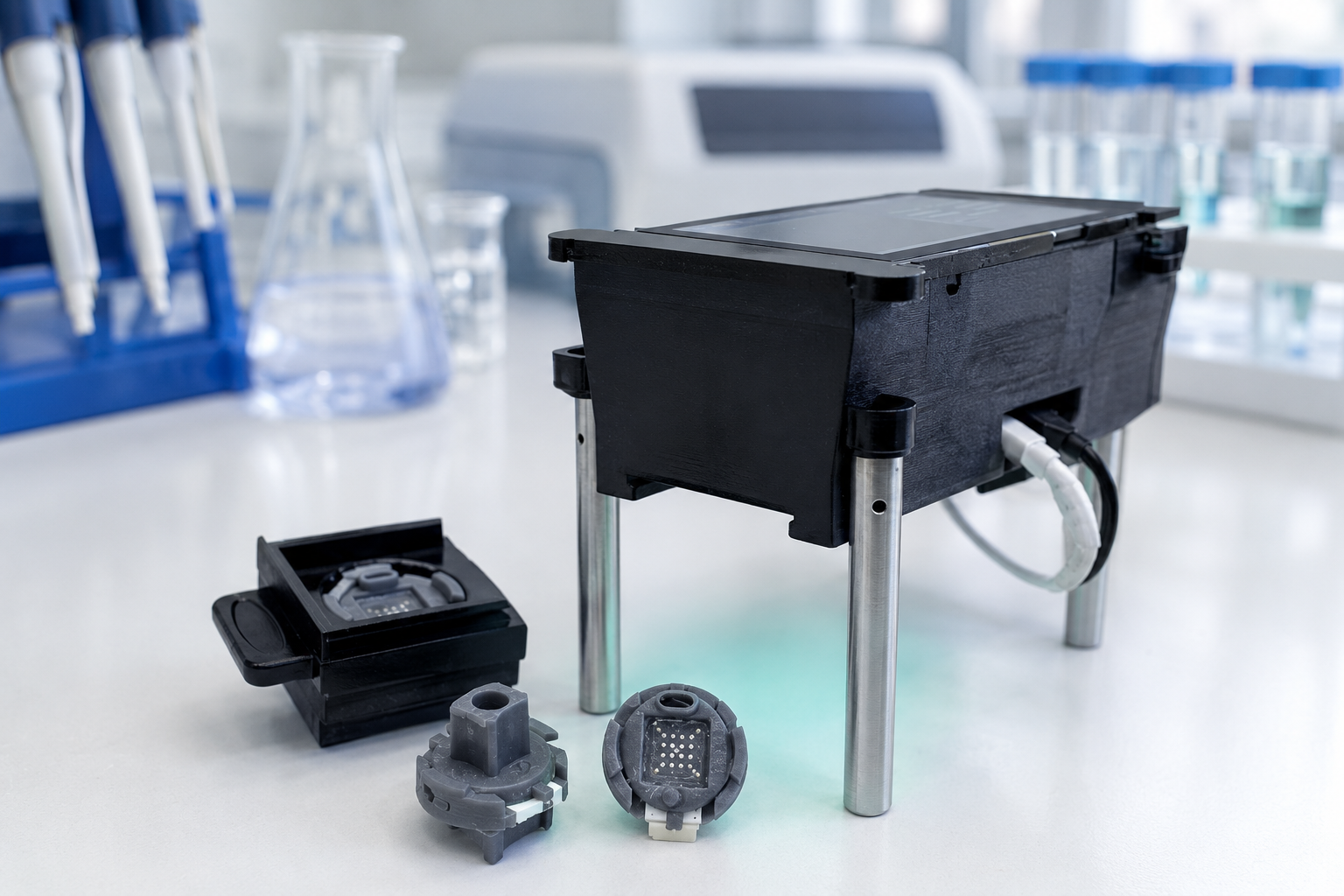
Paper: Deep learning-enhanced dual-mode multiplexed optical sensor for point-of-care diagnostics of cardiovascular diseases
In a study published in Light: Science & Applications, researchers at the University of California, Los Angeles (UCLA), USA, introduced an artificial intelligence (AI)-based dual-mode vertical flow assay (xVFA) platform. The dual-mode and multiplexed paper-based test could simultaneously quantify three cardiac biomarkers, creatine kinase-MB (CK-MB), cardiac troponin I (cTnI), and N-terminal pro-B-type natriuretic peptide (NT-proBNP), within 23 minutes. The xVFA test accurately quantified these biomarkers using neural network models trained on data from 92 patient serum samples. Blinded classification involved samples from 35 patients, while quantification performance was evaluated in biomarker-specific subsets.
These findings suggest that AI-assisted point-of-care testing could support faster risk stratification and clinical assessment, as well as more comprehensive care. The xVFA test may help clinicians assess biomarkers associated with myocardial infarction (MI) and heart failure (HF) while providing information about possible recurrent injury and ventricular wall stress from a single serum sample.
Healthcare professionals require rapid and readily accessible cardiac biomarker test reports to identify high-risk individuals and diagnose cardiovascular conditions such as MI and HF at an early stage. These conditions frequently coexist, and their coexistence is associated with substantially higher rates of recurrent hospitalizations and mortality than either condition alone.
Current central laboratory testing can involve long turnaround times and separate assays. Existing point-of-care systems may have limited sensitivity or dynamic range and often use single-analyte formats. These constraints can limit the ability of available systems to capture the complex pathophysiology of cardiovascular diseases (CVDs). These tests may also require large sample volumes, multiple reagents, and separate cartridges, increasing cost and labor. They may also be unavailable in rural or resource-limited settings or for people with limited mobility.
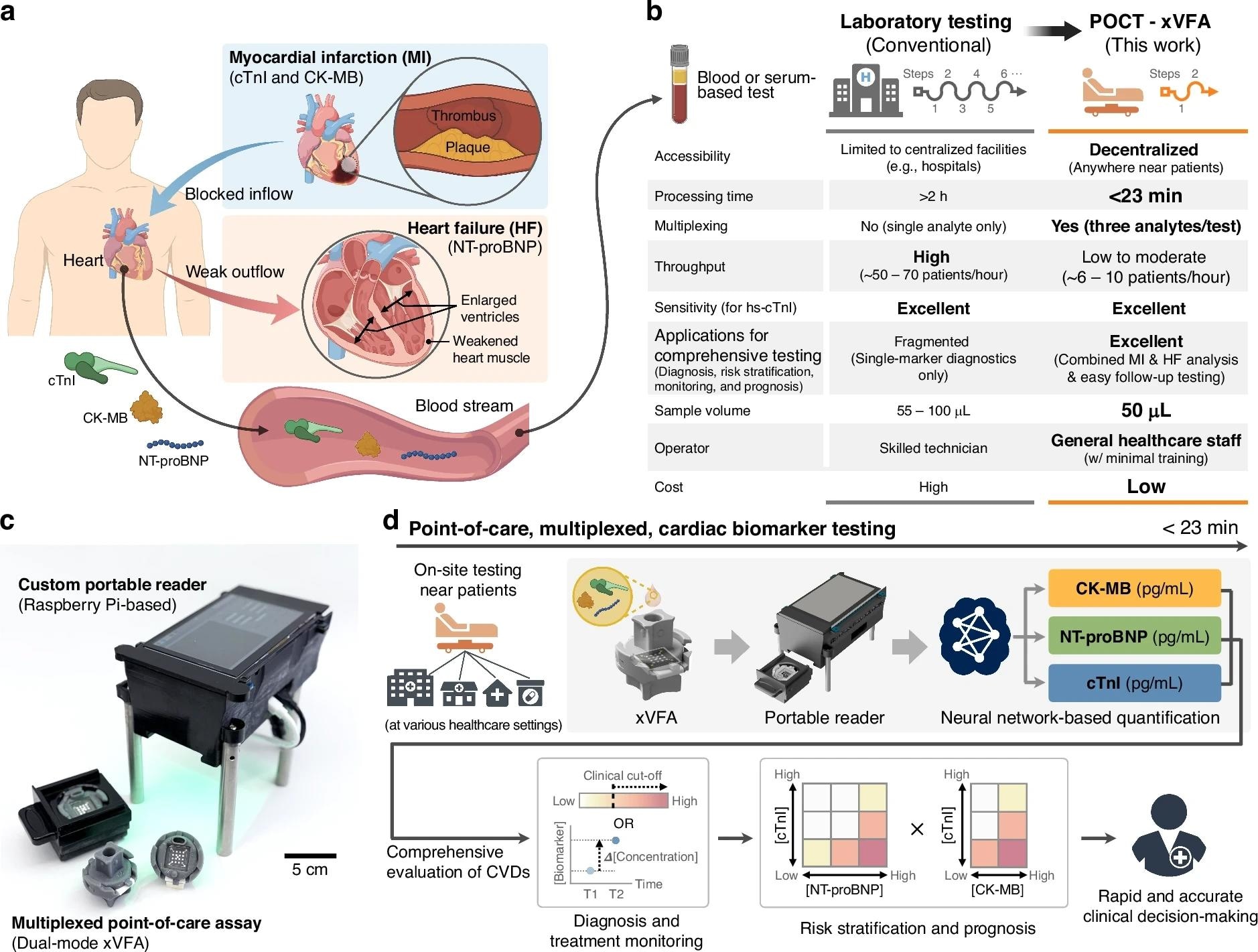
a Pathophysiological relationship between MI and HF, and their associated biomarkers: cTnI and CK-MB for MI, and NT-proBNP for HF. b Comparison between conventional central laboratory testing and the proposed point-of-care dual-mode xVFA optical sensor. Throughput values represent approximate patient-level throughput. For centralized laboratory systems, throughput reflects multiplexed testing that requires independent immunoassays for each biomarker. For the dual-mode xVFA, throughput is estimated by assuming staggered parallel operation of multiple cartridges with a single portable reader, with incubation and washing steps overlapping and only brief imaging steps performed sequentially. All estimates are based on representative commercial laboratory analyzers; actual throughput may vary depending on the clinical workflow. c Image of the dual-mode xVFA system, including assay/imaging cartridges and a custom portable imaging-based optical reader (Raspberry Pi-based). d Workflow of deep learning-powered dual-mode xVFA. The integrated outputs can support a comprehensive evaluation of cardiovascular diseases (CVDs), including diagnosis, treatment monitoring, risk stratification, and prognosis, facilitating rapid and accurate clinical decisions
About the study
In this paper, the researchers present a multiplexed assay that uses a compact optical sensor to obtain data and quantifies the information using deep learning (DL). The sensor combines chemiluminescent (CL) and colorimetric detection in a paper-based cartridge. A 12 mm × 12 mm sensing membrane lies at the cartridge center and contains 16 spots to enable simultaneous testing of the three biomarkers, cTnI, CK-MB, and NT-proBNP. The membrane also has two spots for positive controls and four spots for negative controls. Each biomarker test spot is coated with anti-biomarker antibodies. Positive-control spots are coated with secondary antibodies, whereas negative-control spots contain buffer only.
The first top case contains engineered paper layers that facilitate fluid transport vertically and laterally, whereas the second top case is used for imaging and contains an acrylic window selected after the researchers evaluated cover materials with varying thicknesses. The reader allows image acquisition from the sensing membrane using a graphical user interface (GUI). The programmed GUI allowed manual exposure adjustment to achieve high sensitivity.
The system combines a camera and a light-emitting diode (LED) module to obtain high-resolution images with exposure times ranging from 300 µs to 239 s. The range enables colorimetric detection using shorter exposures and CL-based detection using longer exposures. The researchers imaged colorimetric signals under green light (525 nm) to generate contrast from light absorbed by gold nanoparticles (520 to 530 nm) and captured CL signals in dark settings to collect light generated by chemical reactions.
The team evaluated cross-reactivity in the multiplexed sensor setup by spiking serum samples with varying concentrations of the biomarkers within their clinically relevant ranges. They then applied neural network-based models to data from 92 patient serum samples for biomarker quantification. The dataset was split by patient into training and blinded test sets. The cTnI, NT-proBNP, and CK-MB concentrations were established using reference immunoassays and enzyme-linked immunosorbent assays (ELISA).
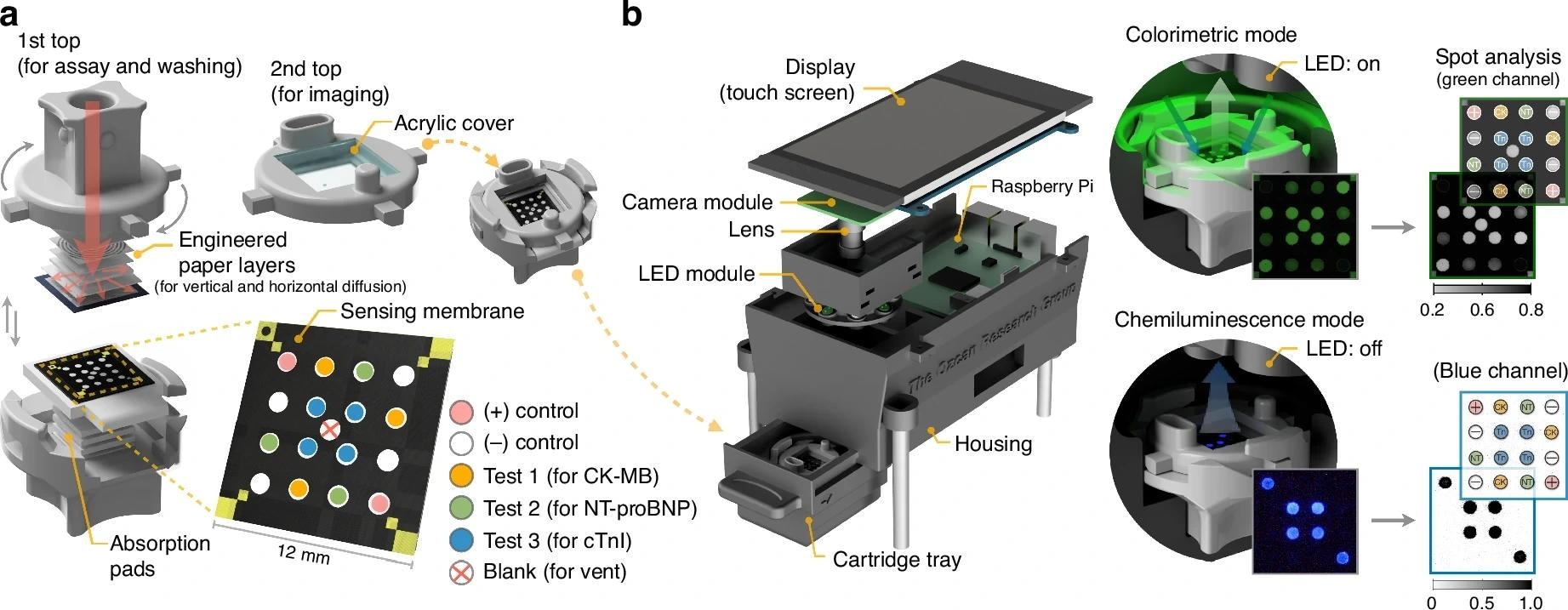
a Design of the dual-mode xVFA cartridge. The first top case is for reagent delivery and washing, while the second top case is for imaging. The bottom case features a multiplexed sensing membrane with 16 immunoreaction spots, including test spots for CK-MB, NT-proBNP, and cTnI, as well as internal positive and negative controls. b Structure of the Raspberry Pi-based portable optical reader and dual-mode imaging setup. Colorimetric signals are captured under green LED illumination (LED on), whereas CL signals are acquired with the LED off. The captured images are processed to identify spots and extract the optical signal intensity
Results
The team found that the xVFA platform accommodated the distinct concentration ranges of all three biomarkers, with combined colorimetric and CL detection spanning nearly six orders of magnitude for cTnI, while maintaining quantification accuracy. From a 50 µL serum sample, the optical sensor simultaneously quantified cTnI, CK-MB, and NT-proBNP cardiac biomarkers in only 23 minutes. This included 10 minutes for the immunoassay, 8 minutes for washing, and less than 5 minutes for imaging.
The dual-mode multiplexed assay covered the clinical reference thresholds for all three biomarkers. In particular, the test could detect cTnI at sub-pg/mL levels and achieve sub-ng/mL sensitivity for the other two biomarkers, spanning their clinically relevant ranges. The limit of detection (LoD) values for CK-MB, NT-proBNP, and cTnI were 409 pg/mL, 40 pg/mL, and 0.12 pg/mL, respectively.
Reference-assay measurements showed that 43 of 92 patients (46.7%) had elevated levels of cTnI and NT-proBNP, and identified nine cases of elevated CK-MB among people with cTnI levels above the threshold. These biomarker patterns were not compared with confirmed clinical diagnoses or outcomes.
Neural network models trained and tested on the 92-patient clinical dataset showed strong agreement with reference measurements during blinded testing. Pearson correlations were 0.966 for CK-MB, 0.986 for NT-proBNP, and 0.988 for cTnI. These correlations were calculated from biomarker-specific quantification subsets: CK-MB used 28 measurements from six patients and nine synthetic spiked-serum samples; NT-proBNP used 33 measurements from 19 patients; and cTnI used 68 measurements from 35 patients. Two cTnI results were labeled undetermined and excluded, while NT-proBNP quantification had lower precision than the other biomarkers.
The platform's simultaneous analysis, sensitivity, compactness, and potential applicability suggest the AI-assisted xVFA platform could assess cardiac biomarkers across community clinics, hospitals, emergency units, and nursing homes. The test could also provide additional clinical context when CK-MB remains normal in people with persistently elevated troponin, although it was not evaluated as a standalone diagnostic test.
Conclusions
Based on the findings, the multiplexed xVFA platform could support rapid quantification of cardiac biomarkers with high sensitivity through a streamlined assay workflow and portable optical reader in a cost-effective manner.
The platform could improve the speed and analytical performance of point-of-care testing (POCT), potentially expanding access to multiplexed cardiac biomarker testing. However, larger prospective, multicenter studies are needed to improve generalizability and accelerate clinical translation.
The study was limited to analytical validation using 92 leftover serum samples from a single site and did not compare xVFA results with patients' clinical diagnoses or outcomes. Whole blood and capillary blood were also not evaluated.
Researchers could further reduce costs by using injection molding for cartridge fabrication and address data privacy and regulatory concerns by using compliance-oriented workflows with diagnostic data clearly separated from personal information. The authors reported a pending patent application covering the xVFA technology, and Aydogan Ozcan serves as an editor for the journal.
Journal reference:
- Han, G. R., Eryilmaz, M., Goncharov, A., et al. (2026). Deep learning-enhanced dual-mode multiplexed optical sensor for point-of-care diagnostics of cardiovascular diseases. Light: Science & Applications, 15, 190. DOI: 10.1038/s41377-026-02275-9, https://www.nature.com/articles/s41377-026-02275-9
 A Flash of Blue Light Helped Cells Overcome a Major Division Defect