Researchers at Aalborg University, Denmark, have spent several years studying insects in Greenland. Their work reveals surprising results: the insects are adapted to both extreme heat and cold, but climate change may alter their behavior and feeding habits. This could have consequences for insects, plants and larger animals across the Arctic.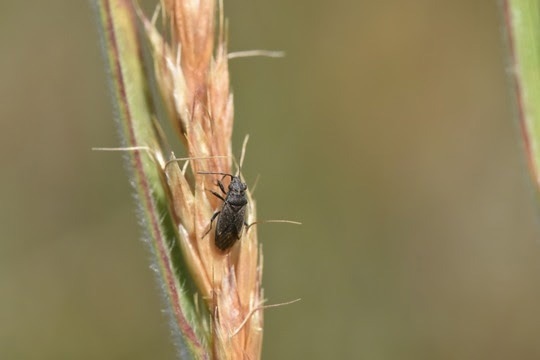
The diet of the tiny seed bug could have major implications for life in Greenland. “Even small changes in a complex food chain can create major ripple effects,” says Simon Bahrndorff, Associate Professor at the Danish Aalborg University’s Department of Chemistry and Bioscience. Image Credit: Simon Bahrndorff AAU
The image of a swimming polar bear has become one of the defining symbols of climate change in the Arctic. But new research from Aalborg University shows that rising temperatures are also affecting some of Greenland’s smallest animals.
For several years, a team of researchers from Aalborg University have been studying the Greenlandic seed bug - a small, inconspicuous insect found almost everywhere in Greenland. Their research shows that the seed bugs respond strongly to changes in temperature.
“We find that the seed bugs can tolerate both extreme cold and extreme heat, but that they may be more vulnerable to warming than previously expected. We also see that their activity and feeding habits change at higher temperatures. Put simply, they eat more and they eat different types of seeds as temperatures rise,” says Simon Bahrndorff, Associate Professor at the Danish Aalborg University’s Department of Chemistry and Bioscience.
According to the researchers, these changes may affect plant communities and determine which seeds are able to germinate.
“This may sound relatively insignificant, but even small changes in a complex food chain can create major ripple effects. When an insect such as the seed bug changes its feeding habits, this can affect which seeds germinate. That can alter vegetation in Greenland and may thus also have consequences for mammals and birds. In general, Greenland’s insect life remains relatively understudied, so there is still a great deal for us to learn,” says Simon Bahrndorff.
Insect Outbreaks in a Changing Climate
The seed bug’s changing feeding habits are not the only sign that Greenland’s insect life may be changing.
When the researchers were in Greenland in 2024, they also observed a sudden outbreak of caterpillars of the great brocade (Eurois occulta) appearing in enormous numbers.
The outbreak was so extensive that, in some places, researchers were literally walking through large numbers of caterpillars.
Very little is known about these sudden population explosions in individual insect species. However, researchers agree that a warmer climate is likely to increase the frequency of such events. Exactly how this will affect Greenland’s environment in the long term remains uncertain.
There is still a great deal to learn about the consequences of human-induced climate change in Greenland. Unfortunately, the changes are happening extremely fast in the Arctic, which highlights the importance of continuing to observe, document and learn. The Arctic is highly vulnerable to climate change, and we see changes here faster than almost anywhere else on the planet. That is both very serious and deeply saddening.”
Sara Nørris Christoffersen, Ph.D. Fellow, Department of Chemistry and Bioscience, Aalborg University
As part of its work in Greenland, Aalborg University sends biology students to the Arctic every year to continue and develop research on the effects of climate change.
 Dr. GPCR and Eurofins Discovery Join Forces to Advance GPCR Drug Discovery