A landmass that broke away from north-western Australia about 150 million years ago and drifted north for the next 100 million years helped lay the foundations for Southeast Asia’s extraordinarily diverse tropical forests, new research has revealed.
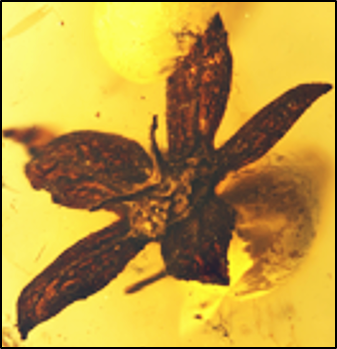 Flower from 99-million-year-old plant in amber with no modern-day equivalent. Image Credit: Curtin University
An international study of more than 3000 fossil specimens preserved in amber in Myanmar has uncovered a diverse plant community dating back about 99 million years, providing a remarkable window into the ancient flora carried north by the West Burma Block before it collided with Southeast Asia about 50 million years ago.
Curtin University co-author Professor Byron Lamont said the findings revealed a remarkable connection between Australia’s geological past and the origins of one of the world’s richest tropical plant regions.
It’s an amazing story of a landmass breaking away from north-western Australia, drifting north across the ancient oceans for millions of years and eventually becoming part of Southeast Asia."
Byron Lamont, Study Co-Author and Professor, Curtin University
“Along the way, it carried a rich tropical flora that evolved in relative isolation near the Equator for tens of millions of years. When the landmass eventually joined Southeast Asia, it helped provide the foundations for the extraordinary plant diversity the region is renowned for today.
“We identified at least 392 morphological types of flowering plants in the amber, alongside an array of ferns, conifers and other ancient plant groups.
“These fossils give us a rare glimpse of that ancient world and help explain the deep evolutionary roots of Southeast Asia’s tropical forests.”
Professor Lamont said the diversity is among the highest recorded for a single fossil plant assemblage from the early to mid-Cretaceous period, when dinosaurs still roamed the Earth.
“Preserved in exceptional three-dimensional detail, the fossils include flowers, fruits, leaves and seeds that offer evidence of a flourishing tropical plant community 100 million years ago,” Professor Lamont said.
“Because the West Burma Block drifted north while remaining close to the Equator for tens of millions of years, this prolonged tropical environment provided a refuge in which ancient plant lineages could survive and diversify.
“The findings challenge the long-held view that Southeast Asia’s diverse flowering-plant ecosystems largely originated much more recently, showing that flowering plants had already diversified extensively in equatorial environments during the Cretaceous period.”
The research is titled ‘A mid-Cretaceous island as a cradle of Southeast Asian plant biodiversity’, and is published in Nature Ecology & Evolution: DOI: 10.1038/s41559-026-03219-7
 Innovative Screening Platform Uses Automated Liquid Handling Solutions to Research Aging