Researchers in the labs of Dr Jan Padeken at the Institute of Molecular Biology (IMB) in Mainz, Germany, and Prof. Susan Mango at the Biozentrum of the University of Basel, Switzerland, have revealed that two major gene-silencing proteins have more than one way to keep genes switched off. SETDB1 and HP1 (known as MET-2 and HPL-2 in C. elegans) are best known for writing and reading H3K9 methylation, a chemical modification associated with inactive genes. The researchers found that these proteins can still silence genes even when their ability to write or read this modification is impaired. This parallel silencing pathway depends on partner proteins that help MET-2 and HPL-2 assemble into concentrated spots, or foci, within the nucleus. Published in Molecular Cell, the findings reveal a new route to gene silencing and broaden our understanding of how cells control gene activity during development.
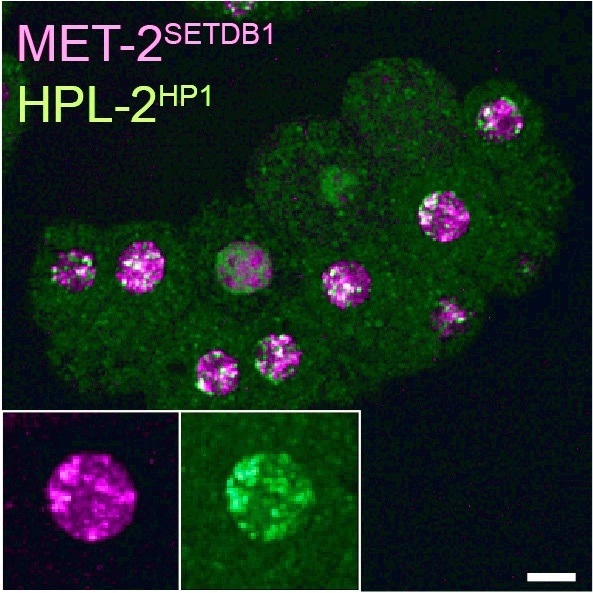 MET-2 and HPL-2 foci in C. elegans. Image Credit: Institute of Molecular Biology (IMB)
All the cells in a developing embryo share the same DNA, and yet they differentiate into hundreds of different cell types with distinct functions. Achieving this requires the cells to activate the right genes in the right cells, while switching others off.
One way cells ensure some genes are kept switched off is by organizing DNA into compact regions called heterochromatin. Heterochromatin is thought to be established by ‘writer’ proteins depositing chemical modifications on histones, which are the proteins that DNA is packaged on. One well-known silencing modification is H3K9me (methylation of lysine 9 on histone H3). H3K9me helps establish gene silencing by recruiting ‘reader’ proteins that help compact the DNA. But is this the whole story, or are there more mechanisms involved?
Separating Proteins From Their Usual Jobs
To investigate this, the researchers studied the tiny roundworm Caenorhabditis elegans. They focused on SETDB1, an H3K9me writer protein (known as MET-2 in worms), and HP1, the H3K9me reader protein (known as HPL-2 in worms). When both proteins were deleted, gene silencing was disrupted and the worms’ organ development was impaired. However, when the team used targeted genetic changes to disable MET-2’s ability to deposit H3K9me or HPL-2’s ability to bind H3K9me, they surprisingly found that genes continued to be silenced and cells still differentiated correctly. This showed that HPL-2 and MET-2 must have an additional way to silence genes, independently of their functions in writing and reading H3K9me.
Protein Partners Condense SETDB1/MET-2 and HP1/HPL-2 Into Silencing Foci
How do MET-2 and HPL-2 silence genes, if not via histone methylation? Jan and his colleagues observed that both these proteins formed concentrated spots, or foci, in the cell nucleus. By testing known protein partners of HPL-2 and MET-2, they found that the formation of HPL-2 foci required direct interaction with a multi-zinc-finger protein called LIN-13, whereas MET-2 foci required binding to the intrinsically disordered cofactor LIN-65. When the researchers specifically deleted the part of HPL-2 that binds LIN-13, it could no longer form foci, and organ development was impaired.
Computer simulations by the lab of Lukas Stelzl (IMB and Johannes Gutenberg University Mainz) and in vitro experiments by the Protein Production Core Facility at IMB revealed that LIN-13 and LIN-65 help condense MET-2 and HPL-2 into heterochromatic foci. This condensation behavior is known to be important for concentrating regulatory factors and establishing highly selective environments (e.g. for silencing genes). The researchers speculate that these MET-2 and HPL-2 foci may create an additional layer of gene repression that operates in parallel with histone methylation to promote gene silencing.
"What I find exciting in this study is that the way molecules condense and organize themselves can have a direct impact on how chromatin is organized, even independently of histone modification signaling.”- Lisa Fol, Study First Author and PhD Student, Padeken lab
A Broader View of Gene Regulation
These findings are significant because they identify a new mechanism of gene silencing and have the potential to change the way we think about how heterochromatin is established. Exactly how MET-2 and HPL-2 foci silence genes remains an open question for future investigation.
The study surprised me at almost every step. It was fantastic to collaborate with the labs of Susan Mango and Lukas Stelzl and with IMB’s Core Facilities. By combining our expertise, we were able to investigate the functions of MET-2 and HPL-2 from several different perspectives and reveal details of their behavior.”
Dr Jan Padeken, Group Leader, IMB Mainz
 Bulky Molecular CRISPR Systems Barely Fit Inside Single Viral Vectors