Researchers from the Australian Research Council Centre of Excellence in Optical Microcombs for Breakthrough Science (COMBS) have developed a powerful new way to use light to measure tiny changes in biological fluids such as blood – using samples as small as a millionth of a drop.
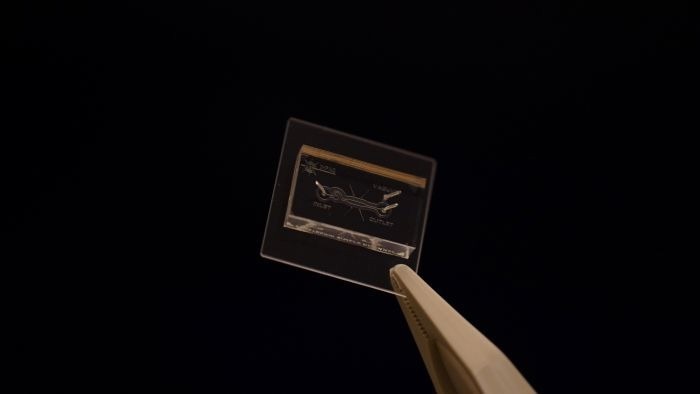 The tiny chip combines microscopic spiral phase plates with a simple microfluidic channel, letting researchers carefully move and control minute amounts of liquid. Image Credit: Crispin Szydzik , RMIT
The breakthrough, led by teams at Adelaide University, RMIT University and the University of St Andrews (UK), could enable faster and more sensitive medical tests, particularly where only very small sample volumes are available. It could also lead to compact lab-on-a-chip devices capable of analyzing tiny biological samples in real-time.
At the heart of the discovery is so-called twisted light – beams that spiral as they travel, just like a corkscrew. This unusual structure gives light a property known as orbital angular momentum, which the researchers measure to probe the physical properties of materials.
Scientists have struggled to measure exactly how much this light is twisting, limiting its usefulness in precision sensing.
That barrier has been overcome through the development of a new approach based on analyzing speckle patterns, the grainy interference patterns produced when light scatters through material.
By decoding these patterns, they were able to measure the twist of light with up to 1000 times greater precision than existing methods.
“We can now detect extremely small changes that were previously invisible.”
The researchers then turned this advance into a practical sensing tool. By generating twisted light inside a microscopic fluid channel, they showed that tiny changes in a liquid, such as its composition, alters how the light twists.
This allowed us to measure the refractive index - a critical property of light - with better than one part per million accuracy, using extremely small sample volumes."
Kishan Dholakia, Study Senior Author and Director, Centre for Light for Life, Adelaide University
The system was successfully tested on sugar solutions and haemoglobin, a key component of blood, demonstrating its ability to analyze biologically relevant samples and its potential for future medical diagnostics.
The results of the tests were published in the journal Nature Communications.
Professor Dholakia said the work opens up new possibilities for translating advanced optical physics into practical technologies.
“We are very excited about where this research can go next,” he said. “It brings high-precision light-based sensing much closer to real-world applications.”
Precise measurement of liquids underpins everything from disease diagnostics to food safety and advanced manufacturing. But existing techniques often require larger sample volumes or complex instrumentation.
“By using twisted light, we have opened the door to faster, earlier diagnosis from just a drop of blood,” said first author Dr Chris Perrella, Adelaide University’s School of Biological Sciences.
“This new method offers a much higher sensitivity with only tiny samples required and the potential for real-time, multi-point measurements, than is currently achievable.”
Future versions of the system could be integrated into compact devices powered by optical frequency combs - laser systems that generate many wavelengths (colors) of light simultaneously - enabling rapid analysis of complex biological samples.
Ultimately, the technology could lead to next-generation point-of-care testing devices, allowing clinicians to analyze blood and other fluids quickly using only minute samples.
 Blood Signature Found to Predict Lung Cancer Risk Years Before Diagnosis