T cells are important mediators of immune responses, contributing to the control of infections and the surveillance and elimination of malignant cells. Scientists at the La Jolla Institute for Immunology (LJI) have uncovered how T cells target paramyxoviruses, which include measles and Nipah viruses.
 Image credit: nobeastsofierce/Shutterstock.com
Paramyxoviruses are diseases of pandemic concern. The measles virus is extremely contagious, while the Nipah virus has a high mortality rate. The new study demonstrates the manner in which T cells can be used to save lives.
Instead of vaccination against individual viruses, the researchers discovered that activating “cross-reactive” T cells may protect against the whole paramyxovirus family. This wide security is crucial since it is unclear which virus will attack next.
No one knows which particular viral species or strain of a virus might be responsible for an outbreak, as we’ve seen in the recent cases of Andes hantavirus.
Alessandro Sette, Dr.Biol.Sci, Study Leader and Professor, La Jolla Institute for Immunology
“Activating T cells can be your first line of defense when you don’t know what’s going to be thrown at you,” added study co-leader LJI Research Assistant Professor Alba Grifoni, Ph.D.
The new Cell Reports Medicine study was funded by the National Institutes of Health's National Institute of Allergy and Infectious Diseases (NIAID) and the Coalition for Epidemic Preparedness Innovations (CEPI).
T Cells are Key to Fighting Emerging Diseases
Each T cell learns to target a particular threat since it is a component of the adaptive immune system. For instance, a T cell may react to an influenza virus infection but not a malaria parasite infection.
Every T cell searches for a certain little molecular site that distinguishes friend from enemy. These sites are referred to by scientists as “epitopes.” T cell epitopes on various pathogens typically differ significantly in appearance.
Despite their capacity to evolve, viruses maintain certain conserved features that are shared across members of a given viral family. Scientists at LJI have demonstrated that certain T cells may “cross-react” to various viruses as long as the epitopes are identical.
Scientists have demonstrated that cross-reactive T cells can identify the familial resemblance between several coronaviruses in a series of seminal research conducted during the COVID-19 pandemic. T cells prepared to identify SARS-CoV-2, the coronavirus that causes COVID-19, may already be present in an individual who has previously caught a common cold coronavirus.
Cross-reactive T cells may provide extensive protection against the fatal Lassa virus and the larger viral family of arenaviruses. According to results, these cross-reactive T cells can be activated by future vaccinations and treatments to provide simultaneous protection against several harmful viruses.
Every study demonstrates the importance of cross-reactive T cells in preventing the spread of new viruses.
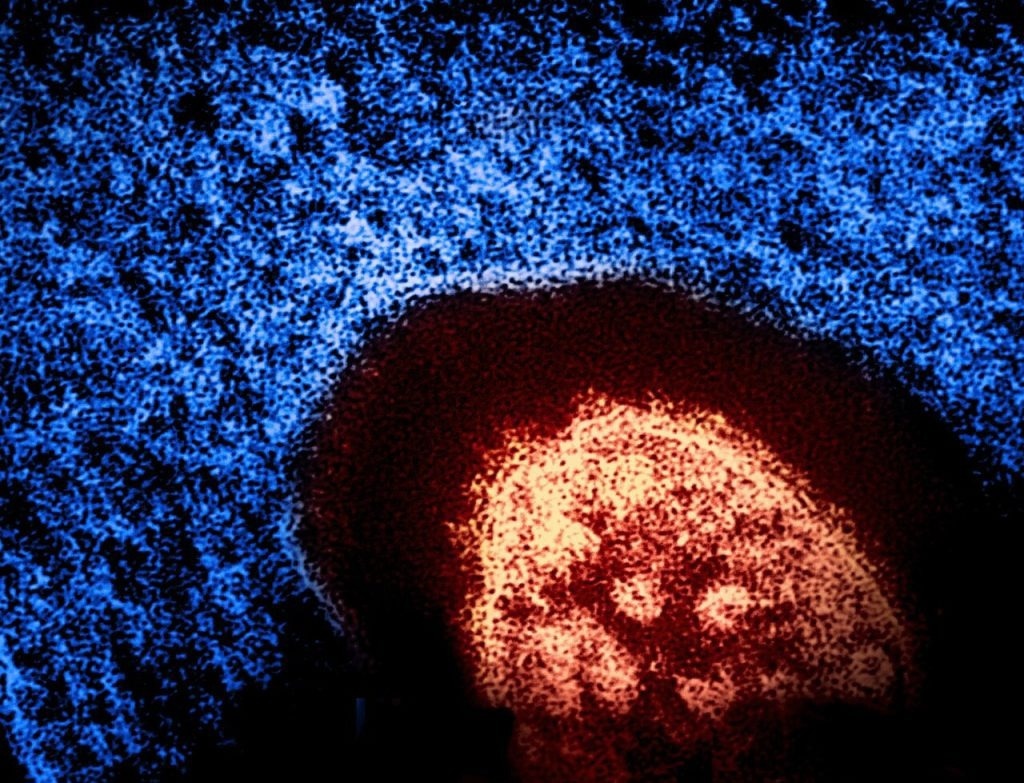 Colorized transmission electron micrograph of a measles virus particle (red). Microscopy is courtesy CDC; layout, colorization, and visual effects by NIAID. Image Credit: CDC and NIAID
Why Paramyxoviruses are a Problem
Doctors and scientists in the United States are focused on one virus in particular: the measles virus. In recent years, a decline in vaccination rates has led to an increase in measles infections. In 2026, there were 2,033 confirmed measles cases in the United States alone. Already, the country is on course to surpass the total number of measles cases in the United States in 2025.
Measles remains a significant global public health concern. People in Southeast Asia should also be aware of a similar hazard, the Nipah virus. Nipah virus is a paramyxovirus transmitted by bats. Cases are uncommon, but they can quickly escalate into fatalities. Nipah virus has a mortality rate of 40 to 75%, which is much higher than that of measles.
Outbreaks are becoming more and more frequent, especially in the Malaysian region.
Alba Grifoni, PhD, Study Co-Leader and Research Assistant Professor, La Jolla Institute for Immunology
According to a recent LJI study, cross-reactive T cells may be the key to combating the hazardous paramyxovirus family.
The researchers collected and examined T cells from the blood of 31 trial participants in collaboration with LJI's John and Susan Major Center for Clinical Investigation. The MMR vaccinations, which guard against serious infection from the rubella virus and the measles and mumps viruses (both of which are paramyxoviruses), were administered to these study participants. As a result, the blood samples included T cells that were prepared to combat the measles infection.
First, the researchers investigated how these T cells detected their attacker. What did the T cells observe when they came across measles? Alison Tarke and Ricardo Da Silva Antunes led experiments to identify T cell epitopes on the measles virus.
Even though measles has been studied for quite some time, and there is a vaccine for measles, there was not a lot known about the specific T-cell response elicited by the measles vaccine.
Alessandro Sette, Dr.Biol.Sci, Study Leader and Professor, La Jolla Institute for Immunology
T Cells Take Aim at Nipah Virus
Alison Tarke and the LJI team subsequently investigated how these same T cells responded to the Nipah virus. Blood testing confirmed that the research participants had never been infected with the Nipah virus. Their T cells had not had the opportunity to “adapt” or learn to target epitopes on the Nipah virus.
Nevertheless, the researchers discovered that certain measles-fighting T cells could detect the Nipah virus. These T cells have the potential to cross-react with two related viruses. The two paramyxoviruses have “conserved” epitopes in common.
“Focusing immune responses on these conserved regions could have a broad, protective capacity for the whole viral family,” stated Sette.
The new study is the first to identify T cell epitopes on the Nipah virus. The researchers were also able to identify a unique epitope shared by measles and Nipah viruses: a portion of the viral fusion, or “F” protein. A substantial proportion of cross-reactive T cells attacked the viral structure, which was relatively small and conserved.
“It appears that if someone is vaccinated against measles, their T cells will have some degree of cross-reactivity to Nipah, That raises the possibility that during a Nipah outbreak, one could perhaps vaccinate people with a measles vaccine, and this cross-reactivity could potentially offer some benefit,” concluded Sette.
Source:
Journal reference:
Tarke, A., et al. (2026) Comprehensive mapping of human CD4+ T cell epitopes for Nipah and measles as prototype Paramyxoviruses. Cell Reports Medicine. DOI: 10.1016/j.xcrm.2026.102838. https://www.cell.com/cell-reports-medicine/fulltext/S2666-3791(26)00255-7.
 Rhizosphere Tug-of-War for Iron Drives Plant-Microbe Evolutionary Co-Adaptation