According to a recent study from the Centre for Genomic Regulation (CRG) in Barcelona, collagen, the protein that forms skin, bones, tendons, and organs, occurs inside cells as a liquid-like droplet rather than the long, rigid rod portrayed in textbooks during the past fifty years.
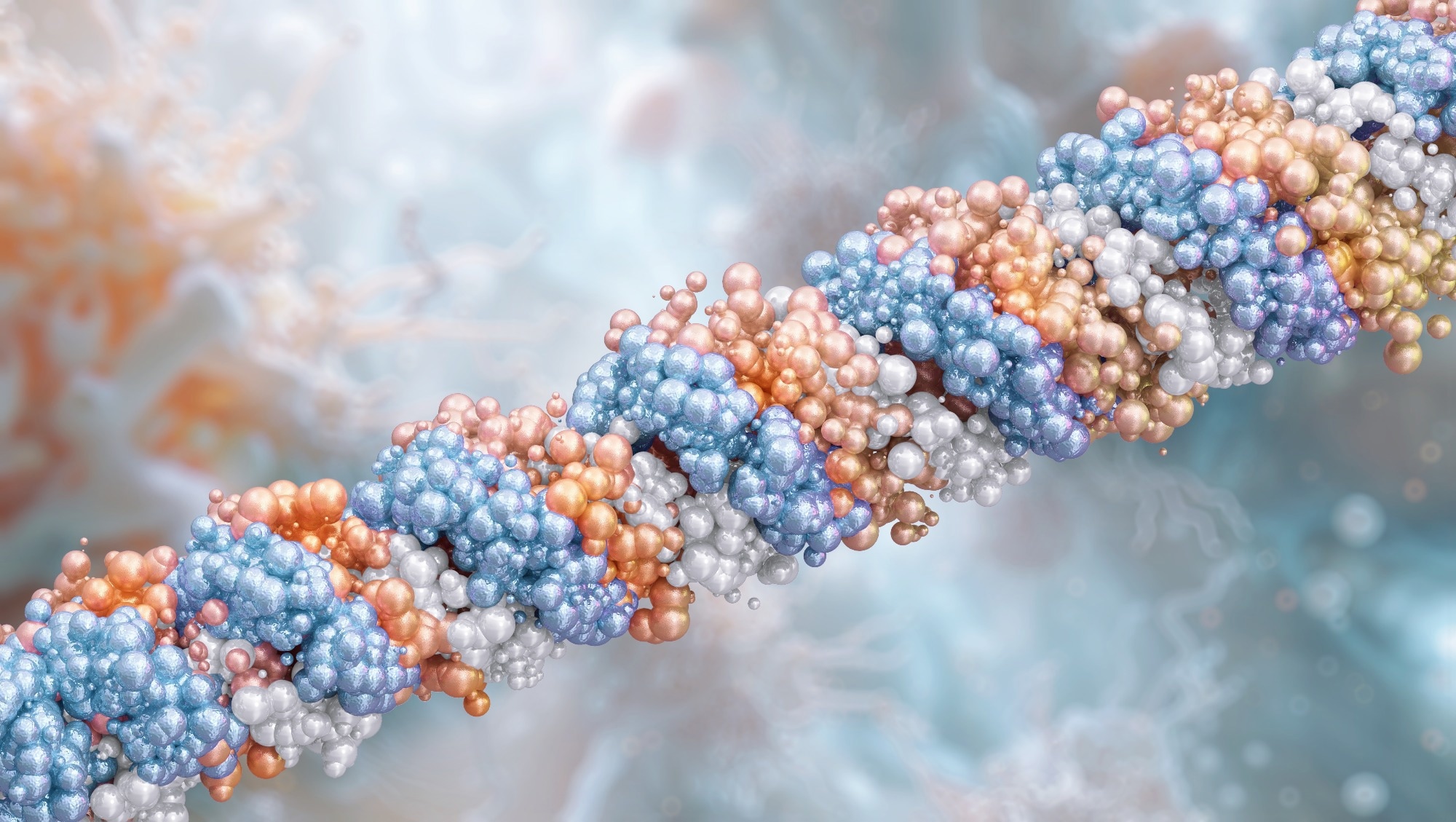 Image credit: Corona Borealis Studio/Shutterstock.com
The finding, published in the Journal of Cell Biology, is the first direct observation of how living cells naturally contain the most prevalent protein in the human body, which accounts for about one-third of the total protein mass.
“Inside a cell, collagens are not rigid molecules as one had assumed. They are in fact very pliable, taking a liquid condensate form much like oil in a drop of water,” explains ICREA Research Professor Vivek Malhotra, senior author of the study at the CRG in Barcelona.
The liquid-like condition may have a protective role. Once outside the cell, collagen's function is to form the stiff fibers that keep tissues together. If this occured within the cell it would be disastrous.
This is another way by which cells ensure that collagens probably never become fibrous inside the cell. Because if it were to become fibrous, it would kill the cell.
Vivek Malhotra, Professor, Centre for Genomic Regulation
The discovery has implications for understanding how the body moves its primary structural building block from where it is produced inside cells. According to the researchers, this process may occur without relying on the receptor- and vesicle-based transport system identified in Nobel Prize winning work performed in the 1980s and 1990s.
Rather, they suggest a "liquid extrusion" theory in which collagens use capillary action to go from their site of synthesis to the subsequent compartment of the secretory route.
A Sixty-Year Puzzle in Cell Biology
The endoplasmic reticulum (ER), a cellular compartment, is where collagen is formed. In particular, the study examined procollagen 1, a precursor form found inside cells that develops into type 1 collagen. About 90% of the collagen in the body is type 1.
Purified collagen appears as a long, stiff rod up to 400 nanometers long under a microscope. Vesicles are the sacs that carry proteins from the place of production to the outside of the cell, but only have a diameter of 60 to 90 nanometers.
The question of how such huge molecules might be transported out of cells has been raised in the field of cell biology since the structure of collagen was first characterized over fifty years ago. The new explanation is that collagen is not yet a rod inside the cell. The protein's classic image depicts collagen only after it has exited cells and formed the fibers that keep tissues together.
The scientists demonstrated how collagen inside human hepatic stellate cells, the liver cells that manufacture collagen and cause scarring in liver fibrosis, collects into tiny droplets that combine, split, and exchange material with their surroundings using high-resolution live-cell imaging.
All of these are indicators of a condensate, which are protein compartments that get so concentrated that they separate from their environment, much like oil droplets in water.
The study's first author, Soumya Bhattacharyya, claims that the majority of cell biology has concentrated on stress granules in the cytosol and condensates in the nucleus.
“We’re just beginning to understand condensates inside the endoplasmic reticulum,” says Bhattacharyya.
The Discovery: “I Had No Idea Where It Would Lead To”
Dr. Soumya Bhattacharyya, a postdoctoral researcher in Vivek Malhotra's team, obtained the results using microscope photographs in May 2024. Bhattacharyya was investigating the effects of increased collagen production in fibrotic cells utilizing the liver cell system.
I had no idea what it would lead to. But when we took the samples, what struck me were these bright spherical structures you can’t miss.
Dr. Soumya Bhattacharyya, Centre for Genomic Regulation
A discovery that contradicts cell biology dogma was initially met with skepticism in the lab.
“I thought it must be an artefact,” says Malhotra.
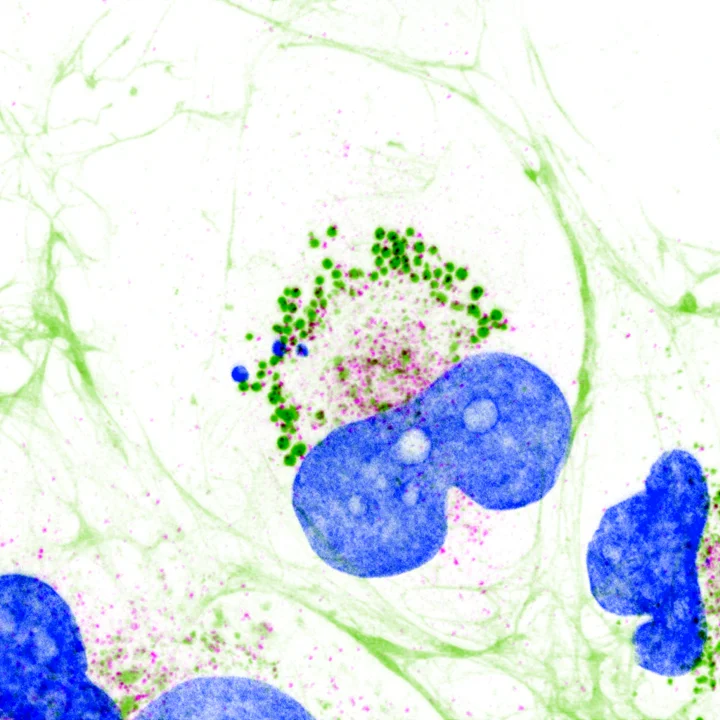 Human liver cells showing collagen droplets inside the cell (green clusters), held in place by TANGO1 (magenta), with extracellular collagen fibers visible as the surrounding network. Cell nuclei are stained blue. Image Credit: Soumya Bhattacharyya/Centre for Genomic Regulation.
The scientists had to decide whether the protein clumping they saw inside the endoplasmic reticulum was junk in the months that followed. Based on a chaperone known as BiP, cells have a complex system in place to identify misfolded proteins and either refold them or mark them for destruction.
The researchers would find elevated amounts of BiP if the collagen droplets were piles of misfolded protein. Instead, a variety of auxiliary proteins, such as chaperones, which are able to identify correctly folded collagen, were present in the droplets.
The Role of TANGO1
Additionally, the study explains the role of TANGO1, a protein identified around 20 years ago by the Malhotra lab and recognized to be necessary for collagen export. Collagen droplets continued to form when the researchers decreased TANGO1, but they were no longer located at the ER exit locations where cargo exits the compartment. As a result, collagen secretion decreased.
According to the findings, TANGO1 does not function as a typical cargo receptor but rather as a mooring point that retains the droplet at the export location. According to the scientists, collagen subsequently exits the cell through a physical process known as wetting, wherein the liquid droplet adheres to and passes through the exit point.
Two potential physical mechanisms for this transmission are proposed by Malhotra.
Imagine you have a rubber ball with a nozzle, filled with liquid. You squeeze it, you force the liquid to come out of this little orifice. Is that the mechanism? Or is the liquid rising by capillary forces, just like nutrients flow up against gravity in plants by capillary action?
Vivek Malhotra, Professor, Centre for Genomic Regulation
Experiments to directly visualize the export mechanism are already under progress, although the suggested liquid extrusion mechanism is still only a model. In order to validate the results in living tissue, the team also intends to create a mouse model in cooperation with outside collaborators.
Implications for Fibrosis and Cancer
The study has implications for targeting the dense matrix that tumors use to protect themselves from chemotherapy and the immune system, as well as for a number of pathological conditions where excess collagen secretion plays a key role, such as liver, lung, and skin fibrosis, if the model is validated.
“One of the major problems in cancer is that the cells secrete so many collagens and other proteins out into the extra cellular matrix that they hide in a shell made of these components and become chemo- and immuno-refractory, meaning they are not seen by the chemical therapeutics or by the immune system,” Malhotra says.
“People are trying to find ways to break this tissue cement and our study could help inform those strategies,” he adds.
According to the suggested collagen secretion model, either dissolving the condensate itself to stop the cargo from being correctly organized in the first place or breaking down TANGO1 to stop cargo from being caught at the exit point could be novel tactics worth investigating.
Source:
Journal reference:
Bhattacharyya, S., et al. (2026) Procollagen 1 assembles into phase-separated condensates in the endoplasmic reticulum. Journal of Cell Biology. DOI: 10.1083/jcb.202603129. https://rupress.org/jcb/article/225/8/e202603129/282730/Procollagen-1-assembles-into-phase-separated.
 Study Details Genetic Divergence Between Astrocytomas and Oligodendrogliomas