An Aberdeen-based researcher has been awarded a highly prestigious international research grant to investigate one of biology’s most enduring mysteries: how completely new traits evolve in animals.
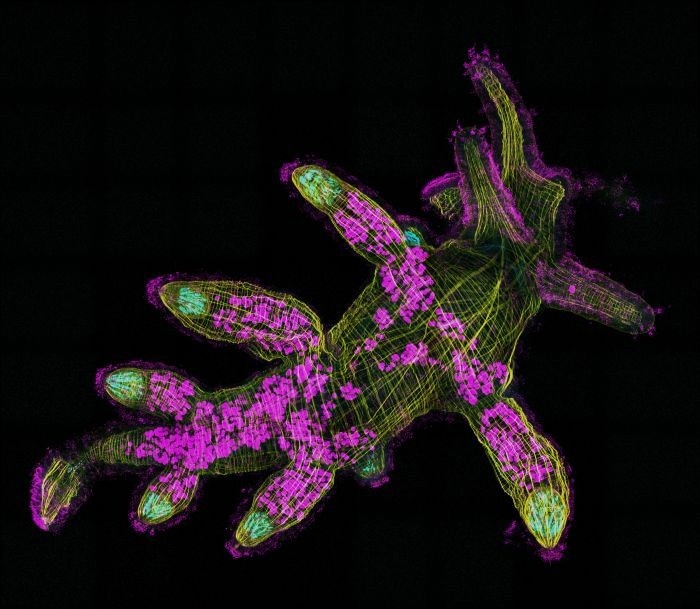
A fluorescent microscopy image of a juvenile sea slug (Berghia stephanieae). This species will be used in the project to study the role of immune receptors in the evolution of kleptocnidy in molluscs, which is the ability to steal stinging cells from prey and use them for defence. In the image the cyan pouches highlight the cnidosacs where the slugs store the stinging organelles for their own defence. Yellow highlights muscle fibers and magenta highlights cilia and digestive tissue. Image Credit: Dr. Jessica Goodheart.
Dr. Victoria Sleight from the University of Aberdeen, is part of an international research team that has secured a research grant from the Human Frontier Science Program (HFSP), one of the world’s most competitive and sought after funding schemes for fundamental science.
The $1.2 million award will support a three year project bringing together researchers in the UK, United States and Japan to explore the genetic origins of evolutionary novelty using the diversity of molluscs.
The project aims to uncover how new biological features arise over evolutionary time. Rather than relying solely on the emergence of entirely new genes, the research focuses on gene family expansion – a process in which genes are duplicated, creating multiple copies that can then evolve new functions.
Molluscs give us a remarkable window into evolution’s creativity. Snails, clams, squid and sea slugs show incredible diversity in form and function, and many of their most striking traits involve incorporating materials or components from their environment.”
Dr. Victoria Sleight, University of Aberdeen
“Examples of this include shells that embed calcium and pigments derived from diet, and sea slugs that can steal stinging cells from their prey and use them for their own defense. We hypothesize that expansions in a group of genes known as pattern recognition receptors have enabled molluscs to safely recognize and integrate ‘non self’ materialsforming the basis of these evolutionary innovations.”
The project will test this idea by studying a wide range of different mollusc species, looking at their genes and how those genes work.
Beyond advancing fundamental evolutionary biology, the findings could reshape how scientists think about the origins of biological complexity and the genetic mechanisms that allow organisms to innovate.
“This project is about understanding the rules that govern life’s ability to invent. By studying how evolution has repeatedly found new solutions in molluscs, we hope to uncover principles that apply far beyond this group alone.”
Dr. Sleight will collaborate with Dr. Jessica Goodheart of the American Museum of Natural History, USA, who will lead the project, and Dr. Manabu Bessho Uehara, of the Frontier Research Institute for Interdisciplinary Sciences, Tohoku University (concurrent appointment: Graduate School of Life Sciences, Tohoku University). Together, the team bring together expertise spanning evolutionary biology, genomics, developmental biology and biochemistry.
 Scientists Build a Genetic Score for Alzheimer’s Disease that Works Across Ancestries