The fever experienced by malaria patients exposes parasites to high temperatures within blood cells. This heat can cause damaged proteins to accumulate inside the parasite, activating defense systems against thermal stress.
 Image credit: 418 House/Shutterstock.com
According to a study conducted by the Barcelona Institute for Global Health (ISGlobal), a facility funded by the “la Caixa” Foundation, Plasmodium falciparum cannot activate these heat-response mechanisms while it is in the gametocyte stage, which is when it spreads infection from humans to mosquitoes.
According to the research, which was published in PLOS Pathogens, individuals who have a high fever can become temporarily non-infectious. If a mosquito were to bite them at this time, it might not pick up the parasite and so not spread the disease to other people.
Malaria affects around 260 million people each year, resulting in approximately 600,000 fatalities. P. falciparum causes the most severe form of the disease and accounts for the vast majority of fatalities.
After being bitten by an infected Anopheles mosquito, the parasites proliferate in the liver. They subsequently infiltrate red blood cells and begin a replication cycle that lasts around 48 hours. During each cycle, only a small proportion of the parasites develop into gametocytes, the only stage capable of infecting a mosquito and hence necessary for malaria transmission.
How and When Does P. falciparum Activate the Thermal Stress Response?
Malaria fever spells often last several hours and can reach 41 °C, which is high enough to trigger an accumulation of misfolded proteins and risk the parasite’s survival.
To deal with this damage, the Heat Shock Response (HSR) is initiated, which protects the cell’s proteins. This reaction causes the synthesis of chaperone proteins, which function as “molecular assistants” to help damaged proteins repair themselves and restore their structure. Malaria parasites, like all organisms, rely heavily on HSR for survival. Until today, it was unknown under which conditions it would activate.
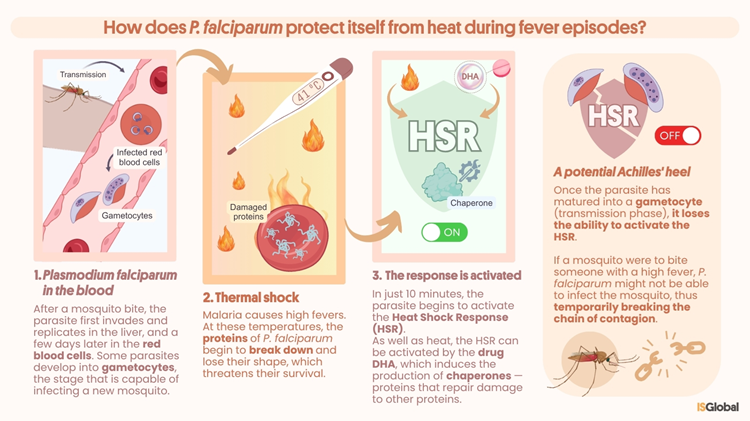 P. falciparum’s response to thermal shock. An infographic illustrating how the malaria parasite withstands episodes of fever and the vulnerability it may exhibit during its gametocyte stage. Image Credit: ISGlobal
The researchers devised a new methodology for subjecting parasites to thermal stress using a water bath instead of an incubator, allowing for more accurate temperature control and the investigation of extremely brief heat exposures. Using this strategy, they discovered that only 10 minutes of exposure is sufficient to activate the HSR.
In P. falciparum, the HSR is regulated by AP2-HS, a transcription factor that controls the activation of heat response genes.
We found that the AP2-HS-controlled response is activated very easily. Even moderate increases in temperature, which do not threaten the parasite’s survival, are enough to trigger this protective mechanism.
Neus Ràfols, Study First Author and Researcher, Barcelona Institute for Global Health
These findings indicate that parasites employ the HSR in a “preventive” mode, which is more efficient than activating it after damage has occurred.
The HSR is Also Activated Following Treatment with the Drug DHA
When the researchers treated parasites with dihydroartemisinin, or DHA (the active compound in artemisinin and its derivatives, which are the most commonly used malaria drugs), the HSR was activated.
These findings point to the HSR as a protective mechanism against a variety of stress that harm parasite proteins, not simply thermal stress. However, parasites with shortened forms (incomplete variants) of the AP2-HS protein are more vulnerable to heat stress, but not to DHA. This might be because DHA impacts several compounds within the parasite, not just proteins.
Gametocytes at Intermediate or Advanced Developmental Stages Do Not Activate the HSR
Only stage I gametocytes can activate the AP2-HS-dependent HSR, in contrast to other stages of the parasite’s life cycle. Gametocytes that are more developed lose this ability.
Our findings suggest that fever could temporarily reduce the ability of a person with malaria to transmit the infection. Although the parasite appears to enhance transmission under stress conditions, mature gametocytes are particularly sensitive to high temperatures.
Alfred Cortés, Study Coordinator and ICREA Researcher, Barcelona Institute for Global Health
“Future studies will need to confirm whether this effect occurs during natural infections and determine whether there is a threshold temperature above which patients become temporarily non-infectious,” concluded Cortés.
Source:
Journal reference:
Ràfols, N., et al. (2026) Characterisation of the thermal and non-thermal stress conditions that activate the Plasmodium falciparum AP2-HS-dependent heat-shock response. PLOS Pathogens. DOI: 10.1371/journal.ppat.1014346. https://journals.plos.org/plospathogens/article?id=10.1371/journal.ppat.1014346.
 Novel Therapeutic Approaches for Malaria Using Anti-Cancer Compound Derivatives