In a study published in Environmental Research, researchers performed radiolabelling to demonstrate, for the first time, that polystyrene nanoplastics can cross the protective Casparian strip and accumulate in the edible tissues of radishes (Raphanus sativus).
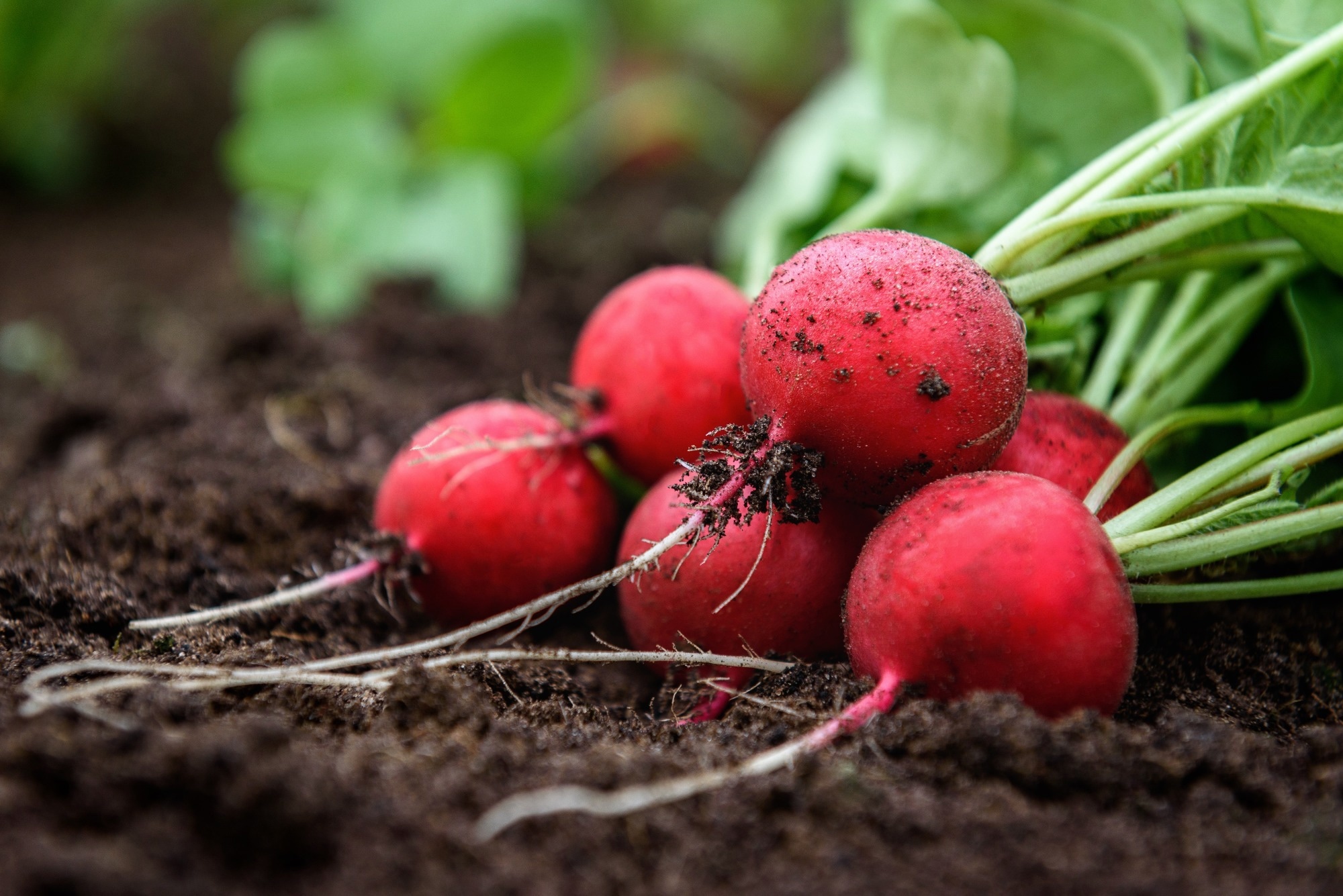 Image credit: Natallia Ploskaya/Shutterstock.com
Approximately 4.4% of nanoplastics were absorbed via roots, with 1.5% detected in above-ground edible tissues, indicating a potential human dietary exposure pathway. These findings suggest that similar uptake may occur in other crops, raising emerging concerns for food safety and agriculture and emphasizing the need for strategies to mitigate nanoplastic contamination in food production systems.
Research on nanoplastic uptake and transport in crops is scarce, primarily due to challenges in detecting and quantifying these particles within plant tissues. While researchers have detected nanoplastics such as polyethylene, polyvinyl chloride, and polystyrene in soils, their concentrations and potential role in human dietary exposure remain uncertain.
Studies reported that nanoplastic exposure can impair crop physiology, reduce shoot growth, and alter metabolic processes. However, whether the effects stem from direct accumulation in tissues or indirect stress responses is unclear. A critical knowledge gap exists regarding whether nanoplastics can cross the Casparian strip system and accumulate in the xylem and edible tissues, with implications for food safety, crop productivity, and agricultural economics.
About The Study
In the present study, researchers utilized a hydroponic system to investigate the potential of radishes to collect nanoplastics in edible portions via crossing the Casparian system.
The experimental design specifically exposed only the non-fleshy-type root fraction of radishes to ¹⁴C-labelled polystyrene nanoplastics (¹⁴C-PS NPs, 100 nm). This practice ensured that any uptake identified in fleshy shoots or roots reflected true internal transport, not surface contamination. The team selected radishes due to their rapid growth and large edible fleshy root, which made them suitable for tracing nanoplastic movement during a five-day exposure period.
The researchers synthesized and characterized 14C-PS NPs using Fourier transform infrared spectroscopy (FTIR) and transmission electron microscopy (TEM) to confirm polymer type and particle morphology. Nanoparticle tracking indicated that the average particle size was 138 nm. They cultivated plants hydroponically in ½ Murashige and Skoog solution (pH 5.5; 230 mL total volume) under controlled growth cabinet conditions (96 μmol m⁻² s⁻¹ photosynthetic active radiation, 12 hours light/12 hours dark periods). The study included two treatments: controls (no nanoplastics) and exposure to ¹⁴C-PS NPs at 500 Bq/mL (121.7 μg/mL), with six replicates per treatment.
After five days of exposure, researchers dissected each radish into three distinct tissues: shoots, fleshy (edible) roots, and non-fleshy roots. They performed liquid scintillation counting (LSC) to quantify radioactivity, calculating tissue concentrations as radioactivity per gram of dry weight. A mass balance approach, combining radioactivity in tissues with remaining radioactivity in the hydroponic medium, enabled the determination of the proportion of nanoplastics adsorbed and transported in the plant.
Results
The study demonstrated that radishes (Raphanus sativus) can uptake and translocate nanoplastics from non-fleshy portions of roots into edible tissues. Radioactivity from ¹⁴C-labelled polystyrene nanoplastics (¹⁴C-PS NPs) was detected in all exposed tissues, while control plants showed no measurable radioactivity (<0.1 Bq/mL), confirming the specificity of uptake.
The team observed the highest concentrations in non-fleshy root portions, which were exposed directly to the nanoplastics; the mean concentration was 216 kBq/g, 23-fold and 63-fold higher than that in fleshy roots and shoots, respectively. The distribution of nanoplastics followed a decreasing gradient with distance from the exposure site: non-fleshy segment of roots > fleshy segment of roots > shoots.
Overall, 4.4% of nanoplastics incorporated into the hydroponic medium accumulated within radish tissues after five days. The team found 65% retained in non-fleshy portions of roots, 25% in fleshy root fractions, and 10% in shoots. Regarding total exposure, the fleshy edible root contained 1.1%, while the shoots contained 0.4%. These findings provide evidence consistent with the idea that nanoplastic substances can cross over the Casparian system, a protective barrier in plant roots, and accumulate in vascular tissues and above-ground edible parts.
Time-course analysis of the hydroponic medium further supported nanoplastic uptake: radioactivity decreased steadily from 515 Bq/mL on day one to 448.5 Bq/mL by day five, representing a 13% reduction. This decline corresponds to the accumulation observed in plant tissues.Top of Form
Bottom of Form
Conclusions
The study provides the first proof-of-principle evidence for the uptake and translocation of nanoplastics in crops. It suggests they can surpass natural root barriers to assimilate into edible plant tissues.
Within five days, polystyrene nanoplastics were transported from non-fleshy fractions of roots to the fleshy shoots and roots of radishes, confirming systemic movement through the vascular system and revealing a potential dietary exposure pathway for humans. These findings raise potential concerns for food safety and agricultural sustainability.
However, limitations such as short exposure duration, a single polymer type, and hydroponic conditions restrict the generalizability of the findings. Future studies should assess diverse polymers and particle sizes, longer exposure times, multiple crop growth stages, and soil-based systems with varying physicochemical properties to better assess real-world nanoplastic accumulation and long-term food safety risks.
Download your PDF copy now!
Journal Reference
Clark, N. J., et al. (2025). Determining the accumulation potential of nanoplastics in crops: An investigation of 14C-labelled polystyrene nanoplastic into radishes. Environmental Research, 122687. doi: 10.1016/j.envres.2025.122687. https://www.sciencedirect.com/science/article/pii/S0013935125019395?via%3Dihub
 How Touch Science Shapes Better Cosmetic Products