Certain animals are able to regenerate missing body parts. After amputation, salamanders and frog tadpoles are able to reconstruct entire limbs. Mammals are unable to. Biologists have been trying to figure out why for decades.
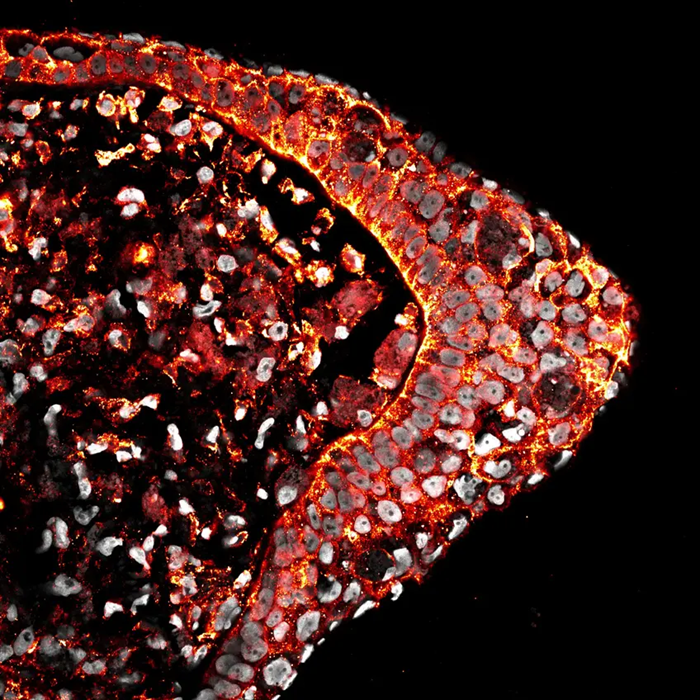 High-resolution fluorescence imaging of a tissue cross-section highlighting cellular boundaries (red) and nuclei (grey). Image Credit: Georgios Tsissios
Wound healing is the first step in limb regeneration. The wounded site's cells must quickly heal the wound and transform into regenerative cell types following amputation. This procedure is seamless in amphibians. It stalls early in mammals. Scar formation takes hold and slows down wound closure, preventing regeneration.
A significant distinction lies in the environment. Amphibian larvae develop in water, where oxygen levels are lower than in the air. Furthermore, many organisms capable of regeneration inhabit aquatic habitats. Meanwhile, mammalian tissues are usually subjected to higher oxygen levels after injury. It is unclear whether this variation directly contributed to regeneration or was just a result of lifestyle.
A team led by Can Aztekin at the Friedrich Miescher Laboratory of the Max Planck Society, found that oxygen plays a key role in limb regeneration. By comparing amputated limbs from frog tadpoles and embryonic mice, the researchers determined that how cells detect oxygen dictates whether regeneration can begin at all.
A Latent Regenerative Capacity
For a long time, regeneration research focused on amphibians, while mammalian regeneration was rarely examined experimentally side by side in a comparable manner. Although many studies showed that regenerative species such as amphibians and mammals share similar genes, suggesting that mammals may retain a latent regenerative capacity, it remained unclear whether mammalian tissues can indeed activate limb regenerative programs, and what prevents them from doing so.
Can Aztekin, Friedrich Miescher Laboratory, Max Planck Society
The researchers removed developing limbs from frog tadpoles and mouse embryos and cultured them outside the body under controlled oxygen conditions. Oxygen levels were reduced to mimic aquatic environments or increased to levels similar to air.
They monitored cellular responses by assessing wound closure, cell movement, gene activity, metabolism, and epigenetic states, including alterations in DNA packaging. The study centered on HIF1A, a protein that functions as a cellular oxygen sensor. When oxygen is low, HIF1A stabilizes and triggers programs that prepare the tissue for wound healing and regeneration.
A Change in Cell Behavior
The limbs of mouse embryos were clearly affected when oxygen levels were lowered. Mouse cells showed signs of initiating a regenerative program and healed wounds more quickly when oxygen levels were lower. Similar results were obtained when HIF1A was stabilized, even in the presence of elevated oxygen levels.
Additionally, low oxygen altered the mechanical properties of skin cells, making them more mobile. Glycolysis, a mechanism that occurs in low-oxygen environments, became the dominant mode of metabolism. Chemical markers on DNA-associated proteins changed concurrently to promote the activation of genes linked to regeneration.
Frog tadpoles showed a different response. Their limbs regenerated effectively across a broad range of oxygen levels, including levels significantly higher than those typically present in air. Molecular analysis indicated that their cells sustain stable HIF1A activity even when oxygen levels rise, due to low expression of genes that normally inhibit this pathway.
By comparing datasets from frogs, axolotls, mice, and humans, the team identified a consistent pattern. Regeneration-capable amphibians exhibit reduced oxygen-sensing capacity, enabling regenerative programs to be initiated and maintained. Mammals display the opposite trend. Their cells respond strongly to oxygen and rapidly deactivate regenerative programs after injury.
Mammalian Limbs Retain Latent Regenerative Potential
The findings indicate that mammalian limbs retain hidden regenerative potential at early stages, depending on how cells respond to environmental cues such as oxygen. This suggests that modifying oxygen-sensing pathways could eventually enhance wound healing or regenerative responses in humans.
Importantly, the results demonstrate the activation of regenerative mechanisms in mammals, not the full regrowth of a complete limb. Although the study does not claim that human limb regeneration is imminent, it shows that differences once considered fixed between species may instead depend on how cells respond to their surroundings.
By directly comparing species that can and cannot regenerate, we bring a fresh perspective to a centuries-old question. Our results show that regenerative programs can be triggered in mammalian tissues and begin to outline a clear, testable path toward promoting limb regeneration in adult mammals.
Can Aztekin, Friedrich Miescher Laboratory, Max Planck Society
Source:
Journal reference:
Tsissios, G., et al. (2026). Species-specific oxygen sensing governs the initiation of vertebrate limb regeneration. Science. DOI: 10.1126/science.adw8526. https://www.science.org/doi/10.1126/science.adw8526.
 Ancient DNA Reveals Extinct Bovine Species in Southern Siberia