Western Sydney University researchers have led the development of Australia’s first national database of arbuscular mycorrhizal (AM) fungi, mapping the hidden fungal networks beneath our feet that support plant health, soil processes and ecosystem resilience.
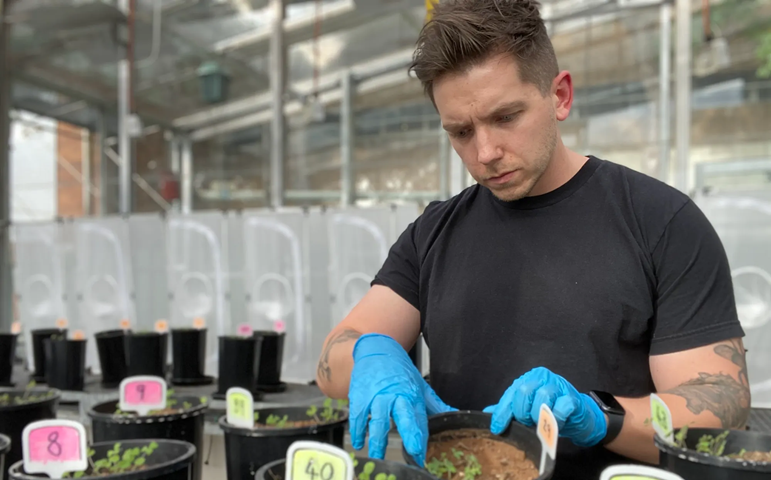 Image Credit: Western Sydney University
The AusAMF database brings together data from mainland Australia and Tasmania, mapping the distribution and diversity of AM fungi - microscopic soil organisms central to plant nutrient acquisition, soil carbon dynamics, and ecosystem resilience.
AM fungi connect plant roots with the surrounding soil and are a critical part of Australia’s ecosystems supporting healthy soils, drought tolerance and ecosystem resilience.
Lead researcher Dr. Adam Frew, from Western’s Hawkesbury Institute for the Environment (now at the Umeå Plant Science Centre, Umeå University), said AusAMF addresses a major gap in understanding Australia’s below ground biodiversity.
Despite making up more than 5 percent of Earth's land area, Australia was represented by only 32 soil samples – only 0.8 percent in the GlobalAMFungi database.
Despite their ecological importance, these invisible fungi have been notably under sampled in Australia, so we can’t fully understand how they contribute to our biodiversity.”
Dr. Adam Frew, Lead Researcher, Institute for the Environment, Western Hawkesbury
“Australia’s soils are ancient and impoverished, and its plant life is somewhat distinct. If we assume what’s true of a European grassland or North American cropland is true here, we’re probably wrong. This database provides new data to let us check.”
The first release of AusAMF contains 610 georeferenced sites sampled between 2011 and 2023, covering all major Australian climate zones and accompanied by standardized soil storage, DNA extraction, and sequencing procedures.
Each sample is linked to environmental variables, allowing researchers to explore ecological drivers of AM fungal distributions, assess patterns of biodiversity and support applications spanning from fundamental ecology to conservation planning.
The database is purpose-built and expandable using harmonized protocols - something not achieved through datasets compiled retrospectively from separate studies. It provides a rare level of methodological consistency, enabling robust comparisons across locations and over time.
Every sample was stored, extracted and sequenced using the same protocols at the same facility.
“This consistency is important,” explained Dr. Frew. “When we see a difference between fields or ecosystems, for example, we can be more confident it’s real ecology, not a difference in laboratory methods.”
Dr. Frew said the AusAMF would continue to grow as an expandable national resource, supporting ecological research and conservation planning.
“This is a foundation. AusAMF is built to grow, and as it does it will let us watch how these fungal communities shift with climate change and changing land use. This is something no other continent can currently do comprehensively at this scale.”
All AusAMF data are freely available, including the raw sequence data and the environmental layers used to build the database.
The project was a collaborative effort involving researchers from across Australia and internationally, with significant support from the Terrestrial Ecosystem Research Network (TERN).
This research was supported by an Australian Research Council (ARC) Discovery Early Career Researcher Award.
AusAMF was supported by the Hawkesbury Institute for the Environment at Western Sydney University.
 Innovative Screening Platform Uses Automated Liquid Handling Solutions to Research Aging